
‘Tamil first. Our emotion, our identity’: Vijay amid Vande Mataram row
10825951 Vijay_e44d92
- ✓10825951 Vijay_e44d92
- ✓The song comes from the prologue to Manonmaniam, written by Manonmaniam Sundaranar in 1891.
- ✓Beyond journalism, Janardhanan is also a screenwriter; his Malayalam feature film Aarkkariyam was released in 2021.
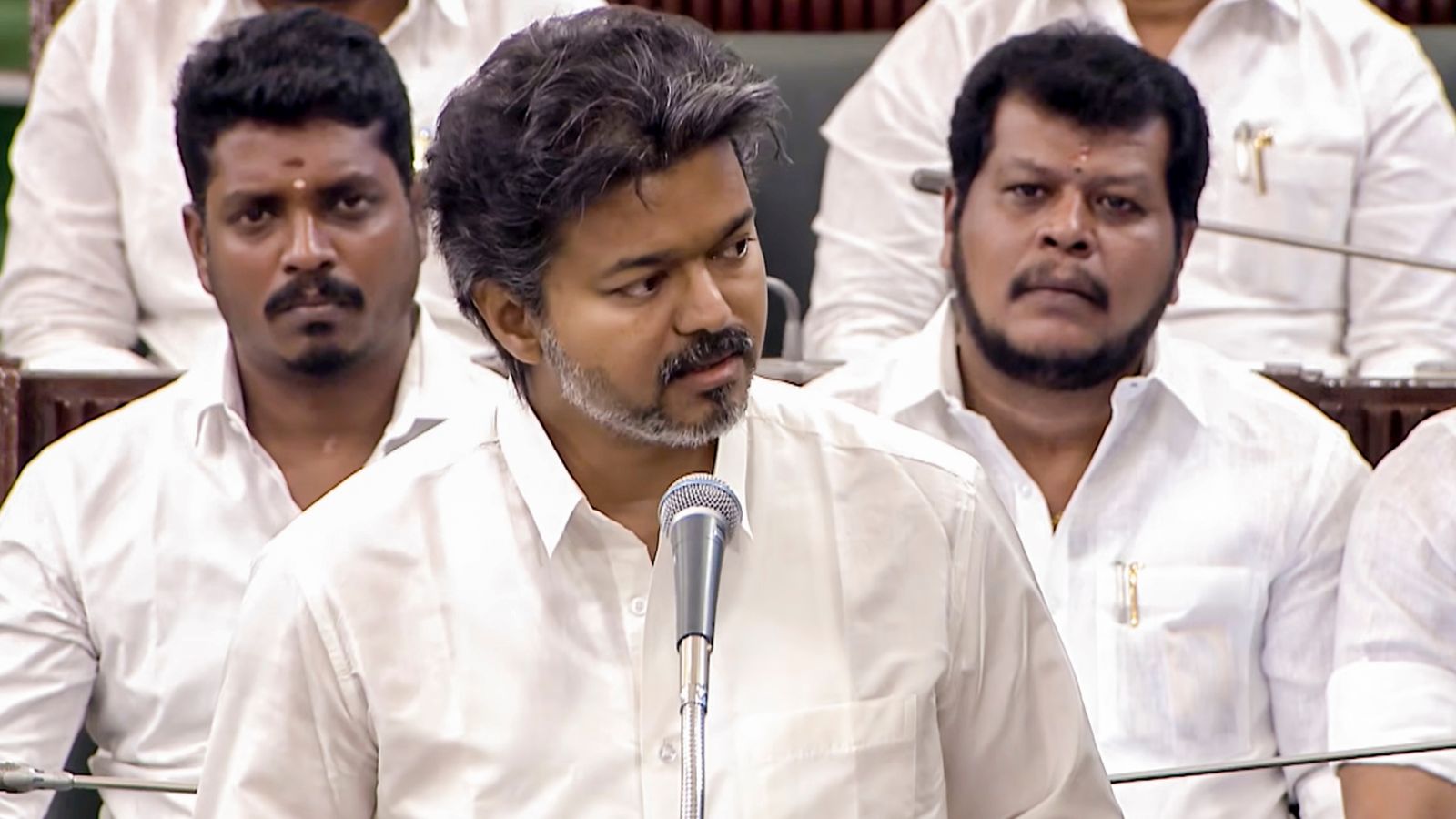
Tamil Nadu Chief Minister C Joseph Vijay on Monday moved a resolution in the State Assembly mandating that 'Tamil Thaai Vazhthu' – the invocation to Mother Tamil — be rendered at the beginning of official functions, reaffirming a practice dating to 1970 amid a fresh dispute over the ceremonial order of songs at government events.
“Tamil is our emotion and identity,” Vijay told the Assembly, arguing that the state could not sacrifice its pride or disregard its own language. “Our mother tongue is as pure as our mother,” he said, describing Tamil as not merely a language but “a culture,” “a thought” and “a love.” Under the resolution, Tamil Thaai Vazhthu is to come first at programmes conducted by government offices, educational institutions, universities, public-sector undertakings and other public institutions.
The immediate dispute arose after the Union Home Ministry asked states and union territories to strictly comply with a January directive requiring Vande Mataram, the national song, to be played before the national anthem at formal official events.
The tension became visible at a recent convocation at Manonmaniam Sundaranar University – an institution named, with some historical irony, after the very scholar who wrote 'Tamil Thaai Vazhthu'. At the ceremony, the Tamil invocation was placed third, after Vande Mataram and the National Anthem, drawing criticism across Tamil Nadu’s political spectrum.
The state government subsequently said the episode would not be repeated. Yet, Vijay is defending an arrangement considerably older than his government. The song comes from the prologue to Manonmaniam, written by Manonmaniam Sundaranar in 1891.
On November 23, 1970, the DMK government issued an order requiring the invocation to be sung at the beginning of government and other specified public functions. Over generations, its roughly 55 seconds became so embedded in Tamil Nadu’s institutional life that generations of schoolchildren, civil servants and university students learned almost instinctively when to rise.
But custom and law were not always identical. That distinction produced an unusual controversy in 2018 when Kanchi Kamakoti Peetam pontiff Vijayendra Saraswathi remained seated during the song at an event in Chennai. Naam Tamilar Katchi functionaries subsequently protested at a Kanchi Mutt institution in Rameswaram.
Three years later, while quashing the resulting criminal case after the parties reached a settlement, Justice G R Swaminathan of the Madras High Court’s Madurai Bench held that 'Tamil Thaai Vazhthu' was a prayer song rather than an anthem and that no statutory or executive requirement then compelled people to stand during its rendition.
The judge nevertheless acknowledged the song’s claim to the “highest reverence and respect.” The DMK government headed by M K Stalin responded days later. On December 12, 2021, it formally recognised 'Tamil Thaai Vazhthu' as Tamil Nadu’s state song and made standing during its rendition compulsory, with an exemption for differently abled persons.
The order also required the song to be rendered at the beginning of official functions. Vijay’s resolution, therefore, adds another political and legislative affirmation to a convention inherited across governments. The dispute is characteristically Tamil Nadu in one respect.
Language here has rarely remained simply a means of communication. From the anti-Hindi agitations to recurring arguments over federalism and state autonomy, Tamil has functioned simultaneously as language, cultural memory and political claim.
That helps explain why something as seemingly procedural as whether one song comes first, second or third can acquire constitutional and emotional weight. The resolution does not challenge the place of the National Anthem or erase the national song.
Its political message instead lies in the sequence — when an official function begins inside Tamil Nadu, the state insists that its own invocation to Mother Tamil should be heard first. Arun Janardhanan is an experienced and authoritative Tamil Nadu correspondent for The Indian Express.
Based in the state, his reporting combines ground-level access with long-form clarity, offering readers a nuanced understanding of South India’s political, judicial, and cultural life - work that reflects both depth of expertise and sustained authority.
Expertise Geographic Focus: As Tamil Nadu Correspondent focused on politics, crime, faith and disputes, Janardhanan has been also reporting extensively on Sri Lanka, producing a decade-long body of work on its elections, governance, and the aftermath of the Easter Sunday bombings through detailed stories and interviews.
Key Coverage Areas: State Politics and Governance: Close reporting on the DMK and AIADMK, the emergence of new political actors such as actor Vijay’s TVK, internal party churn, Centre–State tensions, and the role of the Governor.
Legal and Judicial Affairs: Consistent coverage of the Madras High Court, including religion-linked disputes and cases involving state authority and civil liberties. Investigations: Deep-dive series on landmark cases and unresolved questions, including the Tirupati encounter and the Rajiv Gandhi assassination, alongside multiple investigative series from Tamil Nadu.
Culture, Society, and Crisis: Reporting on cultural organisations, language debates, and disaster coverage—from cyclones to prolonged monsoon emergencies—anchored in on-the-ground detail. His reporting has been recognised with the Ramnath Goenka Award for Excellence in Journalism.
Beyond journalism, Janardhanan is also a screenwriter; his Malayalam feature film Aarkkariyam was released in 2021. ... Read More
- •Aspirants and citizens are advised to monitor official notices and circulars issued by Tamil Nadu State Bureau (Chennai).
- •Verify all prescribed eligibility criteria, cutoff dates, and authenticated document requirements prior to formal submissions.
- •Track connected examination timetables, vacancy advisories, and administrative gazettes on SuchnaSetu.
| Issuing Authority | Tamil Nadu State Bureau (Chennai) |
|---|---|
| Topic Category | STATES |
| Jurisdiction | TN State |
| Publication Date | 10 August 2026 |