
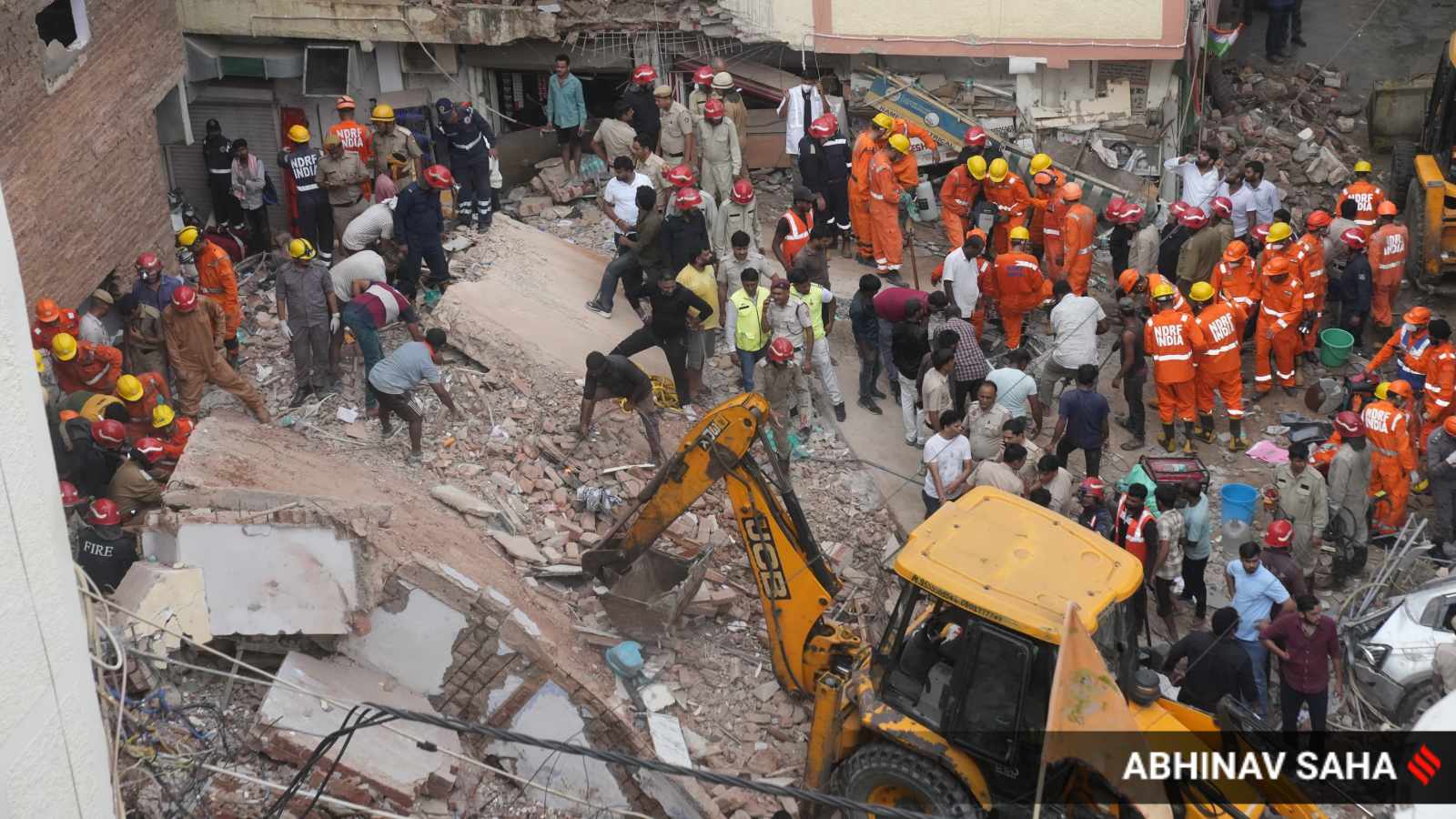
After 7 die in Satya Niketan collapse, PIL seeks hostel policy for Delhi
10868129 satyaniketan
- ✓10868129 satyaniketan
- ✓From recording 750 students at its inception, the varsity now sees approximately 1,32,435 students studying in its regular courses.
- ✓Civic Domain: Categorized under states public notices.
Another public interest litigation (PIL) has been filed in the Delhi High Court after the Satya Niketan hostel collapse that left seven people dead, seeking directions to the Delhi government to formulate and implement a time-bound hostel development policy and to Delhi University to provide hostel facilities in each of its colleges.
The PIL, filed by National Students’ Union of India (NSUI) national president Vinod Jakhar, was mentioned for urgent listing on Tuesday. The court, however, declined to list it urgently. “Can this direction be issued by way of an interim mandamus (order)?
It will be taken up tomorrow. Unnecessarily you waste your own time. Can such a direction be issued (by the court)?,” Chief Justice D K Upadhyaya remarked to advocate Vimal Tyagi, representing Jakhar. CJ Upadhyaya had remarked that the shortage of university and government hostels was forcing students into potentially unsafe PGs and hostels, and questioned whether authorities had done enough to regulate such accommodation.
It directed the MCD to inspect all buildings housing PGs and hostels and prepare a report in a week on whether requisite permission/building byelaws were followed during construction. Jakhar, in his PIL, flagged that the Satya Niketan building collapse “serves as a grave warning regarding the risks faced by thousands of students who are dependent upon privately operated accommodation in different parts of Delhi because their respective colleges do not have adequate hostel facilities”.
He requested that “where sufficient land is available within a college campus, hostel facilities may be constructed or expanded” and where individual colleges “face genuine land constraints, the authorities may develop common/cluster hostels at suitable locations catering to students of neighbouring University colleges”.
Pressing for a university-wide hostel policy, Jakhar in his plea said the authorities are “required to undertake a comprehensive assessment of the residential requirements of students across all colleges, departments and institutions of the University of Delhi”, and undertake “construction or expansion of college hostels… in a phased manner.” He has also written to the offices of Lieutenant Governor Taranjit Sandhu, Chief Minister Rekha Gupta, the University Grants Commission chairman, education ministry and DU vice-chancellor on September 7, highlighting acute shortage of residential facilities for DU students.
Jakhar’s PIL also highlighted that DU, established in 1922, records in its own official description that it was established as a “unitary, teaching and residential University”. From recording 750 students at its inception, the varsity now sees approximately 1,32,435 students studying in its regular courses.
“… more than 104 years have elapsed since the establishment of the University, yet adequate institutional shelter has not been created commensurate with its present student population and geographical expansion,” the PIL noted.
Jakhar said the issue of safe institutional accommodation for students “is not confined to North Campus, South Campus or any particular college or locality”, but is rather a “University-wide problem requiring a University-wide policy response.” According to the PIL, absence of safe institutional accommodation has a “particularly serious impact upon female students, whose families may legitimately have heightened concerns regarding security and safe residential facilities.” Similarly “students from remote areas, economically weaker sections and socially disadvantaged backgrounds similarly face disproportionate difficulties in securing safe and affordable private accommodation.” Sohini Ghosh is a Senior Correspondent at The Indian Express.
Previously based in Ahmedabad covering Gujarat, she recently moved to the New Delhi bureau, where she primarily covers legal developments at the Delhi High Court Professional Profile Background: An alumna of the Asian College of Journalism (ACJ), she previously worked with ET NOW before joining The Indian Express.
Core Beats: Her reporting is currently centered on the Delhi High Court, with a focus on high-profile constitutional disputes, disputes over intellectual property, criminal and civil cases, issues of human rights and regulatory law (especially in the areas of technology and healthcare).
Earlier Specialty: In Gujarat, she was known for her rigorous coverage in the beats of crime, law and policy, and social justice issues, including the 2002 riot cases, 2008 serial bomb blast case, 2016 flogging of Dalits in Una, among others.
She has extensively covered health in the state, including being part of the team that revealed the segregation of wards at the state’s largest government hospital on lines of faith in April 2020. With Ahmedabad being a UNESCO heritage city, she has widely covered urban development and heritage issues, including the redevelopment of the Sabarmati Ashram Recent Notable Articles (Late 2025) Her recent reporting from the Delhi High Court covers major political, constitutional, corporate, and public-interest legal battles: High-Profile Case Coverage She has extensively covered the various legal battles - including for compensation under the aegis of North East Delhi Riots Claims Commission - pertaining to the 2020 northeast Delhi riots, as well as 1984 anti-Sikh riots.
She has also led coverage at the intersection of technology and governance, and its impact on the citizenry, from, and beyond courtrooms — such as the government’s stakeholder consultations for framing AI-Deepfake policy.
Signature Style Sohini is recognized for her sustained reporting from courtrooms and beyond. She specialises in breaking down dense legal arguments to make legalese accessible for readers. Her transition from Gujarat to Delhi has seen her expand her coverage on regulatory, corporate and intellectual property law, while maintaining a strong commitment to human rights and lacuna in the criminal justice...
- •Aspirants and citizens are advised to monitor official notices and circulars issued by Delhi NCR Civic & Governance.
- •Verify all prescribed eligibility criteria, cutoff dates, and authenticated document requirements prior to formal submissions.
- •Track connected examination timetables, vacancy advisories, and administrative gazettes on SuchnaSetu.
| Issuing Authority | Delhi NCR Civic & Governance |
|---|---|
| Topic Category | STATES |
| Jurisdiction | DL State |
| Publication Date | 8 September 2026 |