
Delhi air quality likely to turn ‘Very Poor’ today as winds weaken, farm fires rise
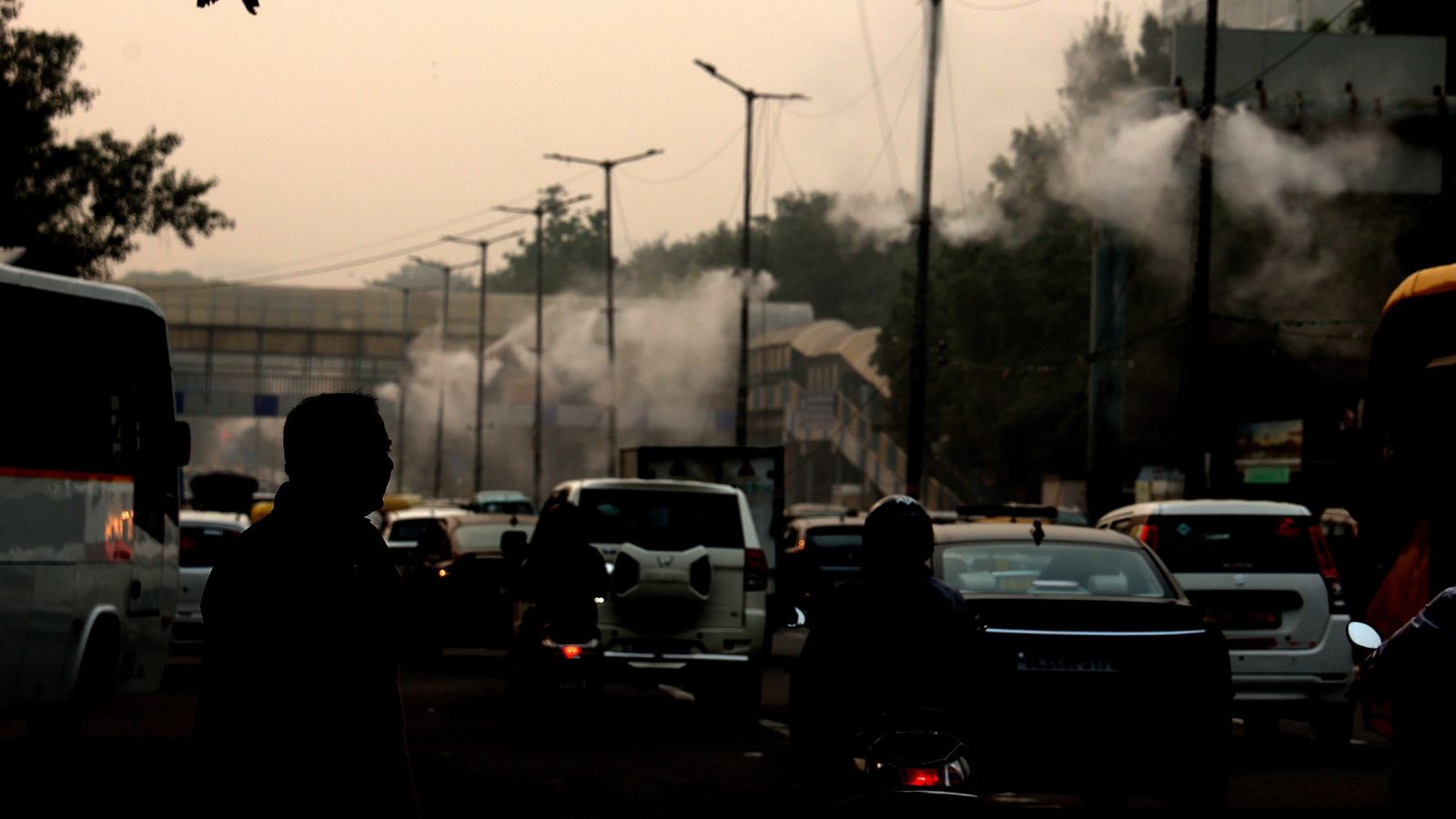
10965615 delhi pollution
- ✓10965615 delhi pollution
- ✓This comes even as the Capital’s 24-hour average Air Quality Index (AQI) improved marginally to 275, in the ‘Poor’ category, on Monday.
- ✓According to the Central Pollution Control Board’s (CPCB) 4 pm bulletin, Delhi’s AQI fell from 290 on Sunday to 275 on Monday.
- ✓Siri Fort recorded an AQI of 424 (Severe), while Punjabi Bagh and Pusa recorded 363 (Very Poor) each.
Delhi’s air quality is likely to deteriorate to the ‘Very Poor’ category from Tuesday as weakening winds, falling temperatures and morning fog are expected to trap pollutants closer to the ground. This comes even as the Capital’s 24-hour average Air Quality Index (AQI) improved marginally to 275, in the ‘Poor’ category, on Monday.
According to the Central Pollution Control Board’s (CPCB) 4 pm bulletin, Delhi’s AQI fell from 290 on Sunday to 275 on Monday. However, several monitoring stations continued to record ‘Very Poor’ to ‘Severe’ air quality.
Siri Fort recorded an AQI of 424 (Severe), while Punjabi Bagh and Pusa recorded 363 (Very Poor) each. ITO, Delhi University’s North Campus and NSUT Jaffarpur recorded 338 (Very poor) each. NSIT Dwarka (328), Burari Crossing (328), DTU (324), CRRI Mathura Road (324), Mundka (319), Chandni Chowk (318), JNU (315) and Aya Nagar (309) remained in the Very Poor bracket.
PM2.5 remained the dominant pollutant at 49 of Delhi’s 59 monitoring stations. In neighbouring NCR cities, Gurugram recorded an AQI of 247 and Noida 214, both in the ‘Poor’ category. The Ventilation Index, which measures how effectively pollutants disperse in the atmosphere, is projected to fall from around 15,000 sq m per second on Monday to 7,400 on Tuesday and 6,000 on Wednesday as winds weaken.
On Monday, stronger afternoon winds and a mixing height – the vertical extent of the lower atmosphere within which pollutants can spread – of around 2,000 m helped disperse pollutants. However, with winds expected to weaken and turn northeasterly, IITM has forecast ‘Very Poor’ AQI from Tuesday.
A higher mixing height allows pollutants to disperse over a larger volume of air, while a lower mixing height traps them closer to the ground. The India Meteorological Department (IMD) has also forecast shallow to moderate morning fog and further cooling over North India.
Visibility at Safdarjung dropped to 400 m on Monday morning. Minimum temperatures are expected to hover around 12-14 degrees Celsius over the next three days. Delhi on Monday recorded a maximum temperature of 27.5 degrees Celsius, 1 degree above normal, and a minimum of 14.8 degres Celsius, 1.3 degrees above normal.
Meanwhile, estimates from IITM’s Decision Support System showed that biomass burning, including stubble burning and domestic biofuel use, was the largest contributor to Delhi’s PM2.5 pollution on Monday at 30.9%. It was followed by mixed combustion sources (27%), followed by secondary organic aerosols (19.6%), secondary inorganic aerosols (8.8%), vehicles (7.5%) and firecrackers (5.8%).
The rise in the contribution of biomass burning comes even as satellite-detected farm fires across the region remained well below historical levels. According to CREAMS Lab at ICAR-IARI, satellites detected 718 crop residue burning incidents across six states on November 15.
Madhya Pradesh accounted for the highest number at 379, followed by Punjab (137), Uttar Pradesh (123), Rajasthan (64), Haryana (12) and Uttarakhand (3). No incidents were recorded in Delhi. Between September 15 and November 15, 12,443 residue burning incidents were recorded across the region.
Punjab accounted for 5,972, up from 4,877 during the corresponding period last year and exceeding its previous full-season tally of 5,114. Other states recorded substantial declines compared to recent years, including Madhya Pradesh (3,399), Rajasthan (1,538), Uttar Pradesh (1,071), Haryana (242), Uttarakhand (219) and Delhi (2).
Within Punjab, Ferozepur, Tarn Taran, Sangrur and Bathinda recorded the highest cumulative fire counts this season. Officials said enforcement had been intensified following directions from the Commission for Air Quality Management (CAQM), with more than 1,850 FIRs registered and over 2,000 red entries made in revenue records against violators as harvesting of late-sown paddy continues, officials said.
- •Aspirants and citizens are advised to monitor official notices and circulars issued by Delhi NCR Civic & Governance.
- •Verify all prescribed eligibility criteria, cutoff dates, and authenticated document requirements prior to formal submissions.
- •Track connected examination timetables, vacancy advisories, and administrative gazettes on SuchnaSetu.
| Issuing Authority | Delhi NCR Civic & Governance |
|---|---|
| Topic Category | HEALTH |
| Jurisdiction | DL State |
| Publication Date | 16 November 2026 |