
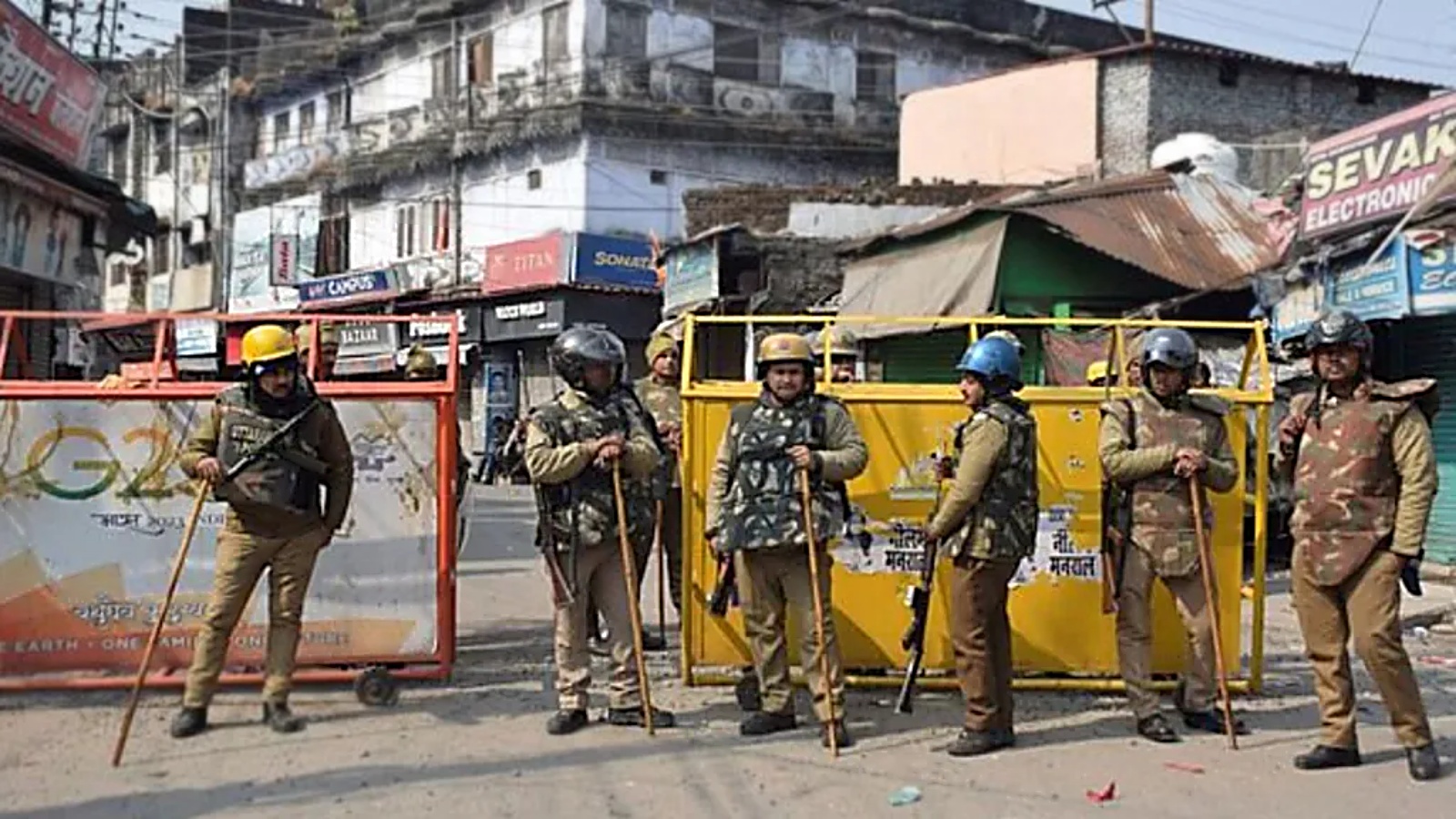
Haldwani turns into fortress ahead of Supreme Court verdict on railway land dispute
10868134 haldwani
- ✓10868134 haldwani
- ✓A joint survey conducted by the Railways and the district administration in 2016-17 identified 4,365 structures as encroachments.
- ✓More than 50,000 people live in the disputed area, according to figures placed before the Supreme Court.
- ✓It has three government schools, 11 accredited private schools, 10 mosques, 12 madrassas, a government public health centre and a temple.
Haldwani’s Banbhoolpura area will be placed under specialised police deployment, divided into sectors, zones and super zones, ahead of the Supreme Court hearing on the railway land dispute on Wednesday, with additional forces being brought in from across Uttarakhand.
More than 50,000 people live in the disputed area, which also has three government schools, 11 private schools, 10 mosques, 12 madrassas, a government public health centre and a temple. Senior Superintendent of Police (SSP) Manjunath TC told The Indian Express that the state police headquarters and Kumaon Range have provided additional forces to Haldwani.
“General alert has been sounded and specialised police deployment has been made,” Manjunath said. The police are also deploying tear-gas squads, anti-riot squads and armed units, along with drone surveillance teams, Manjunath said.
Personnel from the Fire Department, traffic police and other specialised teams will also be deployed. The Local Intelligence Unit (LIU) will also be deployed, along with wireless teams to maintain communication between police units.
“Entire Banphoolpura will be divided into sectors, zones and super zones,” Manjunath said. The exact number of personnel being deployed would be provided by the police later, he said. The case in the top court concerns the land around Haldwani railway station, covering the localities of Gafoor Basti, Dholak Basti and Indira Nagar.
The Railways claims ownership of the disputed land and says structures have been built there without authorisation. A joint survey conducted by the Railways and the district administration in 2016-17 identified 4,365 structures as encroachments.
The scale of the settlement has made the case particularly sensitive. More than 50,000 people live in the disputed area, according to figures placed before the Supreme Court. The area is also not limited to residential structures.
It has three government schools, 11 accredited private schools, 10 mosques, 12 madrassas, a government public health centre and a temple. The dispute has its roots in proceedings before the Uttarakhand High Court relating to illegal sand mining in the Gaula river, which flows alongside Haldwani railway station.
The issue of alleged encroachment on railway land subsequently became part of the litigation. In December 2022, the Uttarakhand High Court directed residents to vacate the disputed land within a week and authorised the use of force, if necessary, to remove unauthorised occupants.
The order triggered protests in Haldwani and led to widespread concern among residents who faced the possibility of losing their homes. In January 2023, the Supreme Court stayed the eviction order. The court raised concerns over the prospect of around 50,000 people being uprooted and said a workable arrangement would have to take into account both the Railways’ requirements and the rehabilitation of affected residents.
The Railways has relied on a 1959 notification, revenue records from 1971 and the findings of the 2016-17 joint survey to support its claim over the land. Residents of Gafoor Basti, Dholak Basti and Indira Nagar, meanwhile, have maintained that many families have lived in the area for decades, in some cases for generations.
They have relied on various documents relating to occupation and property transactions to contest the Railways’ claim. The Railways has said the land is required for the expansion and realignment of infrastructure around Haldwani railway station.
Its requirements include additional railway lines and platforms, a washing pit for cleaning and servicing coaches, a sick line shed for coaches requiring repairs, and stabling lines where railway coaches can be parked when they are not in service.
The Railways has also raised concerns about the vulnerability of railway infrastructure close to the Gaula river. In July 2024, the SC directed authorities to identify the land actually required for railway purposes, determine the families likely to be affected, and work out a rehabilitation plan.
In February 2026, the Supreme Court passed a substantive order in the matter, holding that occupants could not claim a legal right to remain indefinitely on the disputed railway land. At the same time, it directed the authorities to assess affected families for rehabilitation and facilitate applications.
The court also made it clear that residents could not insist on being rehabilitated on the same site. An Award-winning journalist covering the state of Uttarakhand, Vidheesha Kuntamalla has reported on education, policy and social justice.
She has broken news and written investigative stories on education, some of which have prompted responses from central universities and government authorities. She uses the Right to Information Act as a reporting tool and enjoys telling people-driven stories through long-form journalism.
Vidheesha joined The Indian Express’s Delhi City team in 2023, where she has been part of the education coverage in the newsroom, reporting on policy, institutions, and issues affecting students and communities. Her journalism career began in 2020 as a freelance journalist after she left a career in civil engineering.
She covered her home states of Telangana and Andhra Pradesh, focusing on gender, social justice, and politics. Vidheesha Kuntamalla Qualification, Degrees: Master of Science in Quantity Surveying from Kingston University, London Awards and Recognition: Vidheesha won the Ramnath Goenka Excellence in Journalism Award in 2024 for her long-form story on India’s first case of passive euthanasia.
... Read More
- •Aspirants and citizens are advised to monitor official notices and circulars issued by The Indian Express National.
- •Verify all prescribed eligibility criteria, cutoff dates, and authenticated document requirements prior to formal submissions.
- •Track connected examination timetables, vacancy advisories, and administrative gazettes on SuchnaSetu.
| Issuing Authority | The Indian Express National |
|---|---|
| Topic Category | INDIA |
| Jurisdiction | All India / National |
| Publication Date | 8 September 2026 |