
How Satya Niketan grew into a hub for DU students
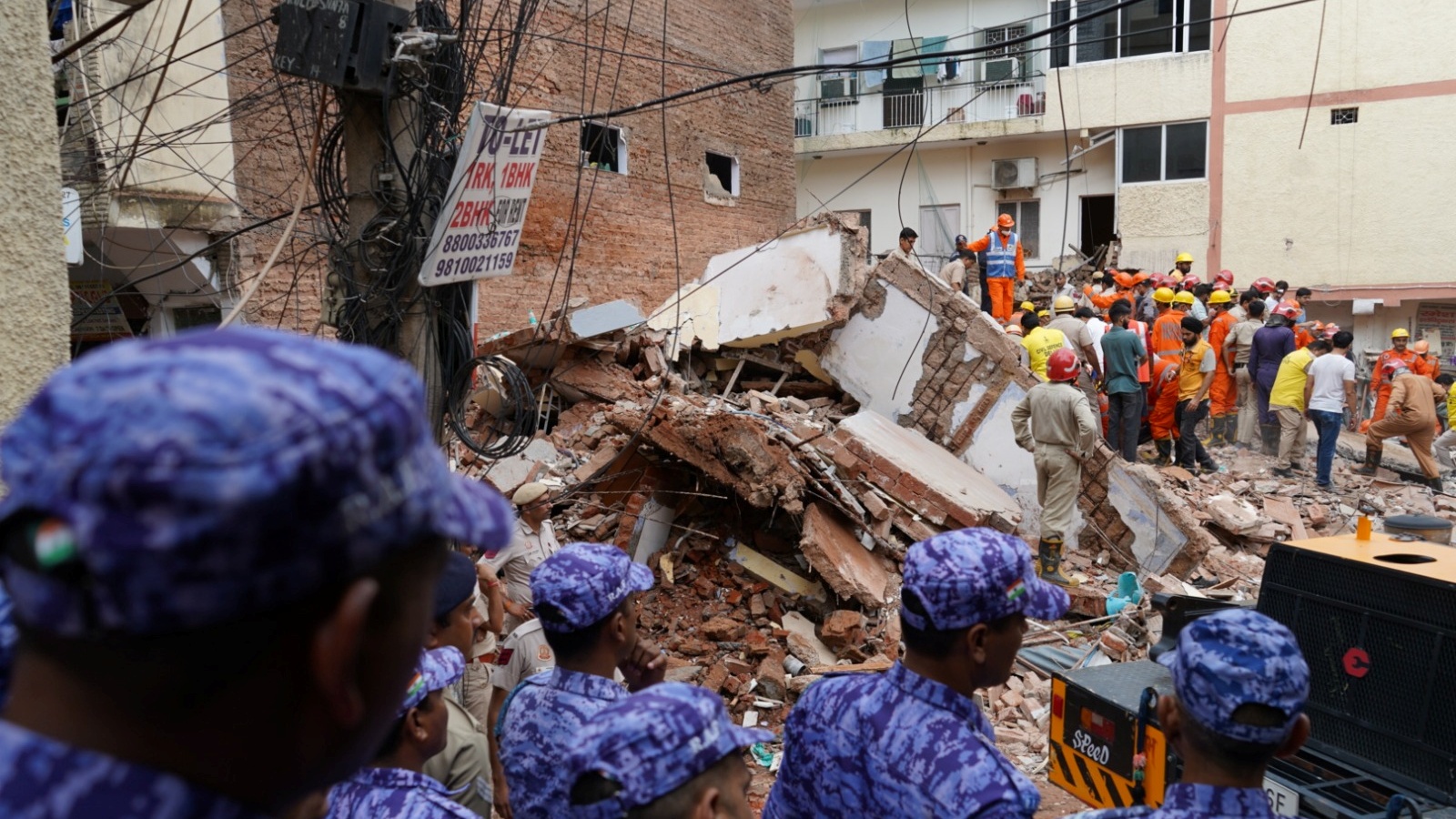
10866305 delhi satya niketan building collapse
- ✓10866305 delhi satya niketan building collapse
- ✓DU’s 2024-25 annual report records over 2.45 lakh regular students while its financial estimates list 18 university-run hostels.
- ✓She joined the Delhi bureau in 2024, and has specialization in Integrated Multimedia Journalism from the Asian College of Journalism (ACJ), Chennai.
- ✓She also focuses on the disparities in Delhi's education system, ranging from elite private schools to government institutions and refugee education.
It stands out as an oddly shaped trapezium in Delhi’s map. Squeezed into a pocket between the Ring Road, San Martin Marg and Nanakpura, Satya Niketan sits directly beside Delhi University’s South Campus. Developed by the Delhi Development Authority (DDA) in 1968 under the Jhuggi Jhopri Removal scheme, residential plots were laid out in the area at up to around 40 square metres.
Nearly six decades on, many of those plots are barely recognisable, having been redeveloped or adapted into paying guest accommodations and private hostels catering to the thousands of students drawn to the colleges nearby.
On Sunday afternoon, a five-storey building — that was turned into a student hostel last year — collapsed in the neighbourhood, killing at least five people and injuring several others. That demand has been reinforced by the limited availability of university hostel accommodation.
DU’s 2024-25 annual report records over 2.45 lakh regular students while its financial estimates list 18 university-run hostels. The university has itself noted that hostel accommodation is limited and that a hostel seat cannot be guaranteed to every applicant.
With hostel places available only to a fraction of the university’s large regular student population, students have traditionally looked beyond campus for accommodation, including in Satya Niketan, Moti Bagh, Anand Niketan and Munirka.
Naraina Vihar and South Extension are also sought-after areas for their direct connectivity to Delhi Metro’s Pink Line. It is not just the housing that has changed. Milk booths, homeopathy clinics and public libraries sit alongside coaching centres, printing and photocopy shops, eateries and other businesses catering to the colleges across the road.
He added, “This is not an isolated phenomenon. We have seen similar patterns in other parts of Delhi, including areas such as Hauz Rani, Munirka and Mahipalpur. The underlying issue is the same — residential areas acquire commercial value, buildings are modified to extract greater value from the land, and enforcement does not keep pace with the changes.” Architect and urban planner Prof P S N Rao, Dean, School of Planning and Architecture, said , “The location advantage gave it the possibility of very high rents, and the pressure to maximise returns has resulted in realtors indiscriminately modifying and adding to buildings.“PG accommodation cannot function as an entirely unregulated market.
Whether a PG is licensed or unlicensed, there has to be transparency about what is permitted and what basic standards have to be met. There needs to be a clear regulatory framework, with enforceable requirements relating to occupancy, ventilation, windows, electricity, water supply and other basic services,” Rao said.
Suptendu Biswas, an architect and urban-designer said, “If basement excavation or any similar structural modification was being carried out beneath an existing building, it would be a very sophisticated engineering exercise.
When you retrospectively excavate beneath a building that is already standing, you are interfering with the system that is carrying the load. If the foundation was exposed or compromised during such work, it could seriously affect the structural stability of the building.” The mushrooming student-housing hub at Satya Niketan is also reflected in how properties in the area are marketed.
Hostel ‘Daze’, which was operating from the building that collapsed on Sunday, had advertised itself on social media as offering “Affordable, Comfortable & Safe” student living in the heart of Satya Niketan, “just steps” from colleges including Sri Venkateswara, Aryabhatta and Motilal Nehru.
Its promotional material also highlighted a rooftop view of Sri Venkateswara College, making proximity to the campus a key part of its appeal. On the challenges with places like Satya Niketan, Biswas said that the modern residential buildings house beyond its permitted capacity.
"For a baseline of 4.5 persons per dwelling unit (around 18 occupants across a four-storey building) the rentals are generally occupied by 40 to 60 tenants… in such areas where land use is no longer residential." This fourfold increase has severely overstrained buildings' electrical circuitry, water use and domestic utility meters, which are deliberately kept on domestic rates rather than commercial connections to evade higher tariffs, he said.
Meanwhile on the challenges, Prof Rao added that a boom in digital aggregator portals and unverified online property listings have worsened the situation. "Nowadays, you have so many platforms and portals where property owners simply upload an address and advertise it as student hostel accommodation, operating commercial lodging enterprises in full public view without securing municipal completion certificates, fire clearances, or trade licenses." Sophiya Mathew is a Correspondent at The Indian Express, based in New Delhi.
She joined the Delhi bureau in 2024, and has specialization in Integrated Multimedia Journalism from the Asian College of Journalism (ACJ), Chennai. Professional Background Core Beats: Her reporting is primarily focused on the Environment and Education.
Specialization: She has gained recognition for her ground-level reporting on the Yamuna floodplains and the socio-economic challenges faced by those living on its banks. She also focuses on the disparities in Delhi's education system, ranging from elite private schools to government institutions and refugee education.
Recent Notable Articles (December 2025) Her recent work has been heavily centered on Delhi's severe winter pollution crisis and the government's regulatory responses: 1. The Air Pollution Crisis "A tale of two cities: Delhi govt schools choke in bad air, private classrooms set up air filters" (Dec 20, 2025): A high-impact feature contrasting the "Clean Air Bubbles" in elite schools with the reality of government school students who are exposed to an equivalent of 17 cigarettes...
- •संबंधित उम्मीदवार अथवा नागरिक Delhi NCR Civic & Governance के आधिकारिक पोर्टल पर समय-समय पर जारी अतिरिक्त दिशानिर्देशों का अवलोकन करें।
- •अधिसूचना में उल्लिखित समय-सीमा, पात्रता शर्तों एवं आवश्यक दस्तावेजों की पूर्व जांच सुनिश्चित करें।
- •सूचना सेतु पर इस विषय से जुड़ी आगामी परीक्षा तिथियों, भर्ती विज्ञापनों और परिणाम अपडेट्स को ट्रैक करते रहें।
| जारीकर्ता प्राधिकरण | Delhi NCR Civic & Governance |
|---|---|
| विषय श्रेणी | STATES |
| क्षेत्र / अधिकार क्षेत्र | DL State |
| सार्वजनिक तिथि | 7 सितंबर 2026 |