
‘I must be wrong’: When mathematician Neena Gupta cracked a 65-year-old mystery
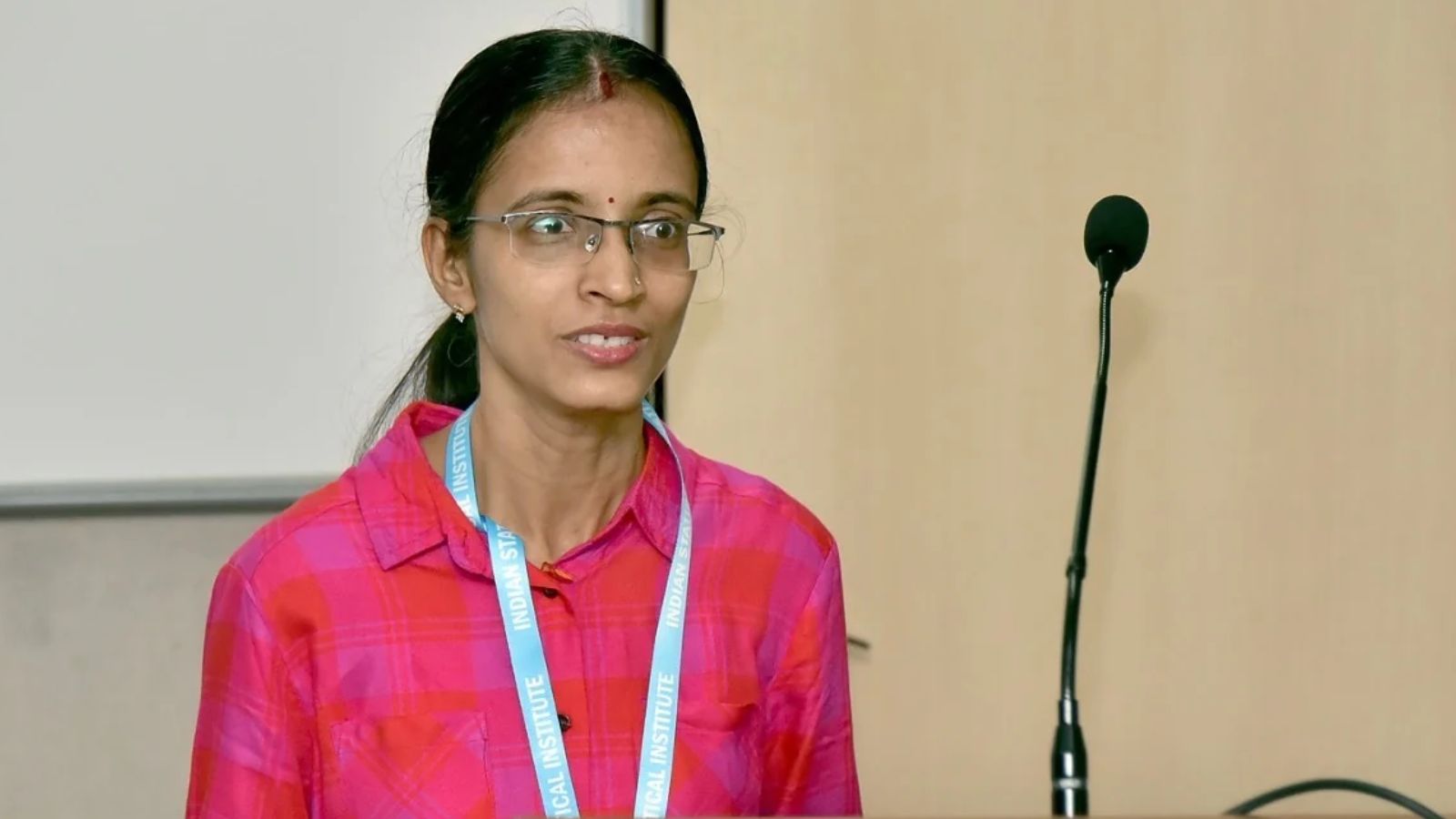
10978075 25-neena-gupta-mathematician
- ✓10978075 25-neena-gupta-mathematician
- ✓It was during a professor’s visit in 2011…When I was going through his paper, I came across an example.
- ✓Civic Domain: Categorized under education public notices.
Indian mathematician Neena Gupta, a professor at the Indian Statistical Institute (ISI), has been named in the TIME100 Next India List 2026 for her work in algebraic geometry. The 42-year-old first gained international recognition in 2014 when she resolved a version of the Zariski Cancellation Problem, a mathematical puzzle that challenged researchers for 65 years.
Her work revived interest in a field many believed had reached a plateau. Born in West Bengal, Gupta completed her BSc (Hons) in Mathematics from Bethune College in 2006, followed by a master’s degree from ISI in 2008 and a PhD in algebra from the institute in 2011 under Professor Amartya Kumar Dutta.
Q: What inspired you to choose the Zariski Cancellation Problem? Neena Gupta: This is one of the most interesting problems in the field. My area of research is affine algebraic geometry, which is guided by many fascinating problems.
These problems are fundamental and basic in nature. They often appear simple and approachable, but some of them turn out to be extremely difficult. In fact, it can take years for mathematicians to come up with an idea or approach to solve such problems.
Q: How long did it take you to solve this problem? Was there a time when you wanted to give up? If so, what inspired you to continue? Gupta: I don’t think there is a specific time when I started. When I joined my PhD programme, I read about some challenging problems in affine spaces.
That was in 2008. I was doing my thesis work…studying many things on my own, when my supervisor told me, ‘you can read up on this as this is new…very interesting’. It was during a professor’s visit in 2011…When I was going through his paper, I came across an example.
I wondered whether I could use these techniques to algebra varieties. I had a brief conversation with the professor, but he was very polite and said that this is a very difficult problem, and that I am young and should focus on my thesis.
I was a bit discouraged, but later on, when I had free time, I went through the example again. And it actually worked. So this is how it started. Q: How did you feel when you solved the problem? Gupta: My initial reaction was, maybe I am wrong…it can’t be done so easily.
So I waited for some days. I waited for Professor Shrikant Mahadeo Bhatwadekar and Professor Amartya Kumar Dutta, who went through everything and assured me that everything was right, and I need not worry. Then I started sharing my paper with experts in the world and soon started getting so many congratulatory emails.
It seemed that the work had revived interest in affine algebraic geometry, which appeared to be dying because the problems had become almost intractable. Gupta: Mathematics is one of the most interesting and intriguing subjects in the world.
I was good in almost all the subjects. But mathematics has a different charm. It covers almost all the areas and is very, very interesting as a subject in its own right. I like mathematics, but I always thought of it as a subject of application rather than a subject of research.
Q: How can people get over their fear of maths? Gupta: It’s a subject that originated in India. I don’t know why we have started feeling like it’s a difficult subject. Probably, we ourselves have created the fear that this is something difficult.
It is a subject where you have to do your work. You have to study. You have to do the problems. It’s not like somebody is solving a problem and you are memorising the trick. You need to know why it is happening. It also requires a lot of practice.
Once there is clarity in ideas, you will start understanding it and enjoying it. Q: What message do you have for the future generation, especially in the age of AI? Gupta: AI has sped up the process of research, and I think it will be useful in the long run.
It can assist mathematicians in different ways. For example, it can carry out complex computations or reveal known results. In that sense, it is an assistant that helps mathematicians know what is already known so they can carry out complex computations.
It will surely be of great help to mathematicians. Now, the question is: is AI good or bad? Will it ruin mathematics? I don’t think AI has reached that stage. Like, for example, the Zariski Cancellation Problem…I don’t think AI has got the maturity for such questions.
Asking valid questions is very important…I think it’s human beings who can do that now. Q: What are you looking forward to? Any new math problems?
- •Aspirants and citizens are advised to monitor official notices and circulars issued by West Bengal State Bureau (Kolkata).
- •Verify all prescribed eligibility criteria, cutoff dates, and authenticated document requirements prior to formal submissions.
- •Track connected examination timetables, vacancy advisories, and administrative gazettes on SuchnaSetu.
| Issuing Authority | West Bengal State Bureau (Kolkata) |
|---|---|
| Topic Category | EDUCATION |
| Jurisdiction | WB State |
| Publication Date | 25 November 2026 |