
India first, study abroad later: Why more students are choosing to stay home for college
10850745 study abroad in india cambridge
- ✓10850745 study abroad in india cambridge
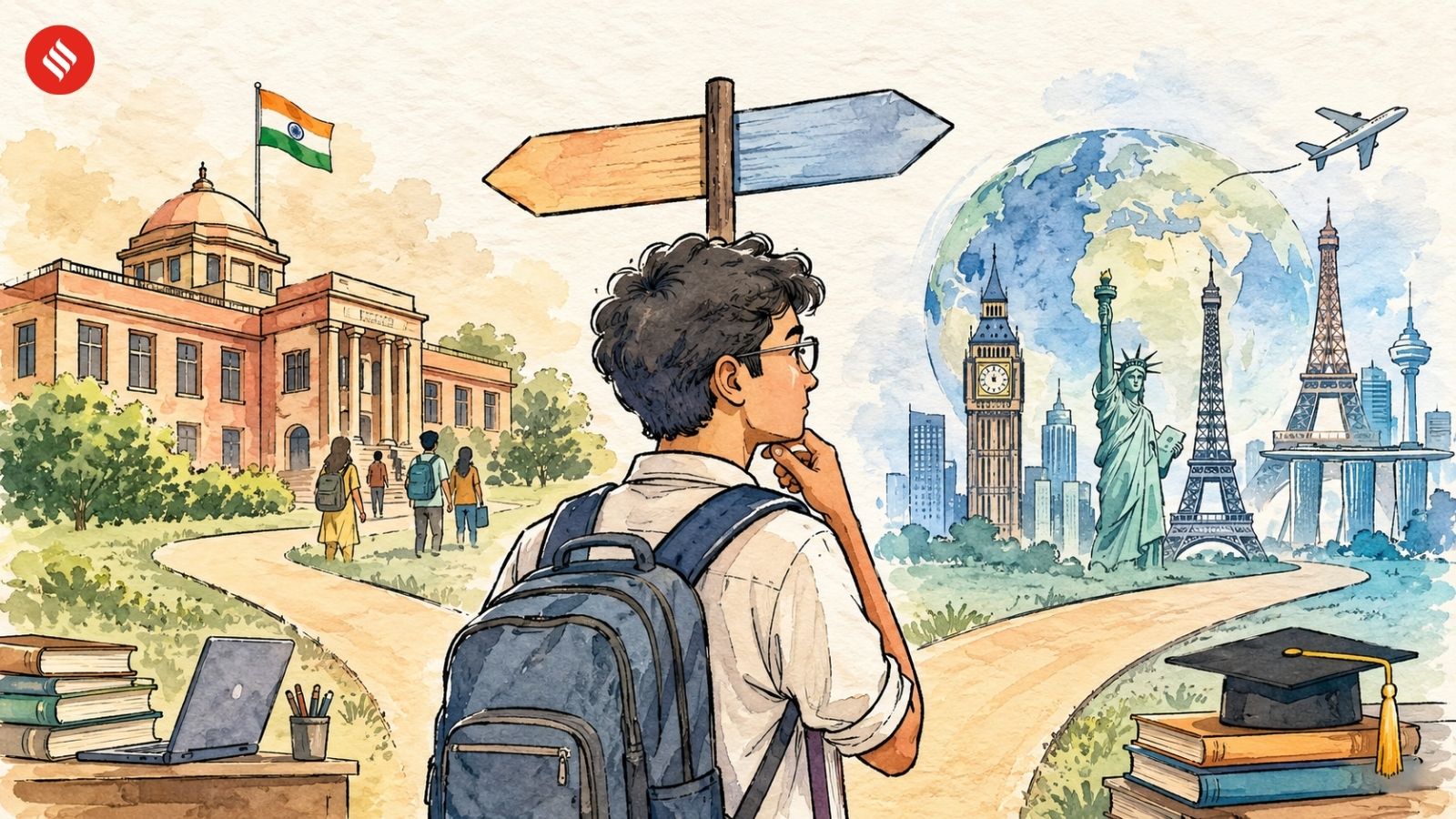
- ✓In 2025, half of all Cambridge learners in India who were headed to university chose to stay in India for their undergraduate degree.
- ✓A year earlier, that figure was 47%.
- ✓Meanwhile, the share heading overseas for undergraduate study slipped from 42% to 40%.
The number is small, but it tells a big story. In 2025, half of all Cambridge learners in India who were headed to university chose to stay in India for their undergraduate degree. A year earlier, that figure was 47%. Meanwhile, the share heading overseas for undergraduate study slipped from 42% to 40%.
These are not dramatic swings. But they are consistent, and they point in one direction. This is the central finding of the Cambridge Destination Survey 2025-26, which polled 404 schools across 49 countries, reaching an estimated 24,637 learners.
In India alone, 112 schools responded. Released this week, the report goes further than just reporting a dip in outbound numbers — it calls this a "structural shift," not a blip caused by a rough year of visa headlines or a weak rupee.
The word is worth pausing on. A structural shift implies something that stays, even after the immediate pressures — cost, visas, geopolitics — ease off. To understand why the report's authors are confident enough to use that word, it helps to hear from Rod Smith, Group Managing Director of Cambridge International Education, the international qualifications arm of Cambridge University Press & Assessment.
In an interview with indianexpress.com, Smith was asked directly whether this shift is real or just a temporary reaction to a tough economic and political moment. His answer reframes the entire debate. "The definition of value in education is changing," Smith said.
"Learners are moving from evaluating the value of a degree to evaluating the value of the entire pathway — from education, to employment, to long-term opportunity." That single line does a lot of work. It explains why Indian families are not abandoning the idea of an international education.
They are simply moving the moment at which they invest in it — from the undergraduate years to the postgraduate years, when the return, in Smith's words, is "often perceived to be stronger and easier to evaluate." The report's own language backs this up.
It describes what used to be the standard route — school, then an overseas Bachelor's, then a global career — as increasingly being replaced by a longer one: school, then an Indian university, then an overseas Master's, then the same global career.
The destination hasn't changed. The order has. The report's most noticeable phrase for what is happening in India is that the country is "becoming its own biggest competitor." Indian universities are no longer just the fallback option for students who cannot afford or cannot get into an overseas degree.
They are increasingly the preferred first choice. Respondents to the survey pointed to a set of reasons: better-quality private and interdisciplinary institutions, more foreign university branch campuses setting up inside India, and wider recognition of international qualifications like Cambridge's own curriculum by Indian universities themselves.
Smith points out that Cambridge's curriculum lets students combine subjects across disciplines — mathematics with economics, say, or computer science with physics — and that a growing number of Indian universities are now offering the same kind of flexible, multidisciplinary combinations, in areas like data science, business analytics and artificial intelligence.
As Indian institutions start to look and feel more like the overseas options students once had to leave the country for, the decision to stay becomes easier. But the picture isn't uniform across South Asia, and the exceptions are as telling as the trend.
Sri Lanka stands apart. Outbound demand there has stayed resilient, even as the same pressures around cost and visas apply. One school counsellor's comment, cited in the report, sums up why: most Sri Lankan students would still prefer to study abroad, but if the cost is too high, they simply have no other option.
In other words, in Sri Lanka it is affordability, not appetite, that is holding students back — a different story from India, where preference itself appears to be shifting. What does not appear to be shifting is the underlying ambition.
Smith is clear that Indian students "haven't lost their global ambitions." Counsellors in India, Pakistan and Bangladesh all reported the same pattern of a local undergraduate degree being treated as a stepping stone to a foreign postgraduate one.
And even as the traditional "Big Four" destinations — the US, UK, Canada and Australia — lose some of their pull, interest hasn't disappeared; it has spread out toward Singapore, the UAE, Germany, Japan, South Korea, Ireland and the Netherlands.
So the honest way to read this data is not "Indian students are choosing India over the world." It is closer to this: Indian students are choosing India first, and the world second — and doing the maths more carefully than before about when, and why, that second move should happen.
- •Aspirants and citizens are advised to monitor official notices and circulars issued by Indian Express Education.
- •Verify all prescribed eligibility criteria, cutoff dates, and authenticated document requirements prior to formal submissions.
- •Track connected examination timetables, vacancy advisories, and administrative gazettes on SuchnaSetu.
| Issuing Authority | Indian Express Education |
|---|---|
| Topic Category | EDUCATION |
| Jurisdiction | All India / National |
| Publication Date | 30 August 2026 |