
Kargil War shaped his childhood, innovation shaped his classroom: Meet National Teacher Awardee Mohd Mustafa
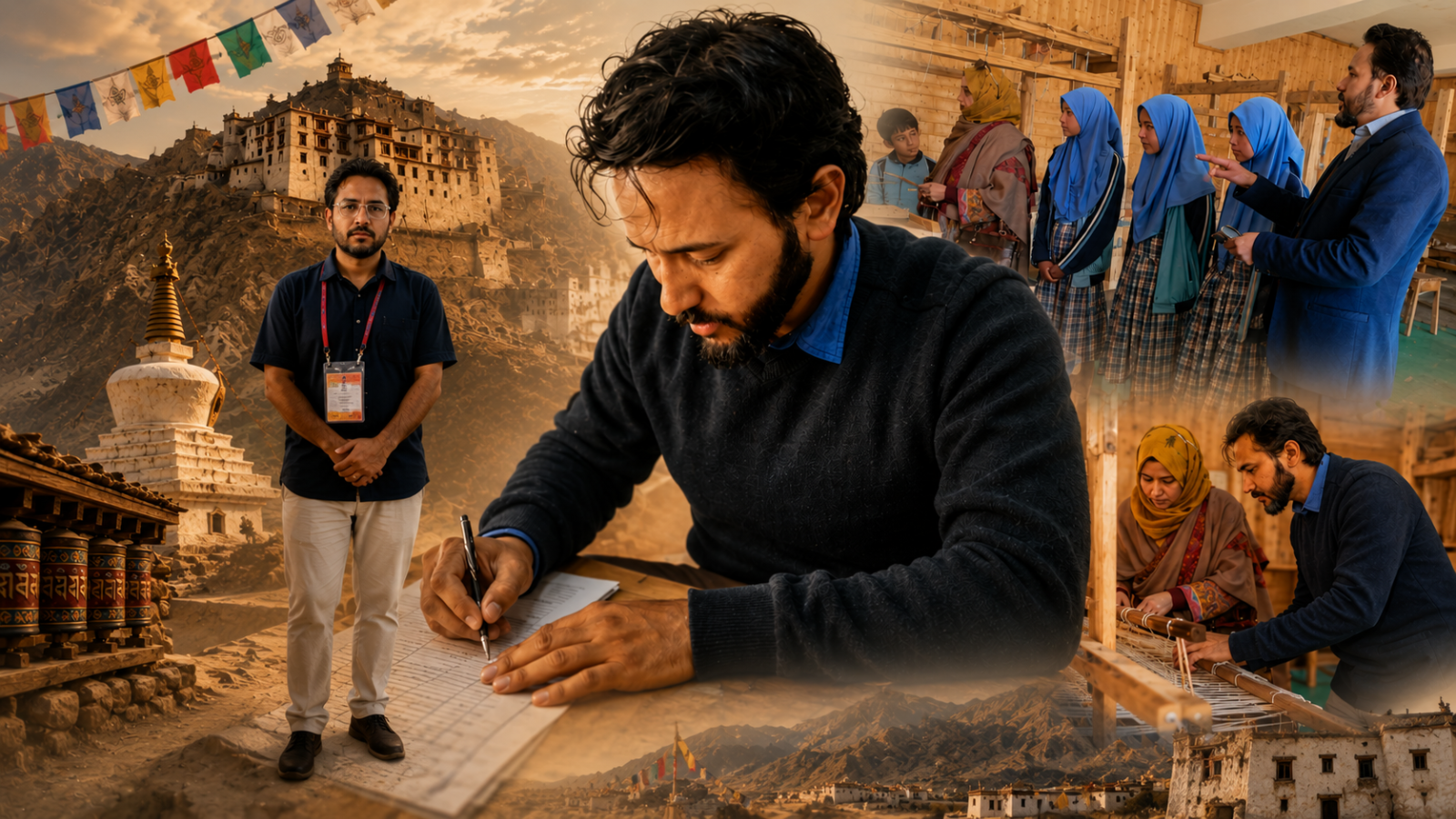
10863484 Mohd Mustafa Kamal
- ✓10863484 Mohd Mustafa Kamal
- ✓A school teacher from Wakha village near Kargil, Mustafa, is among the shortlisted recipients of the National Teachers Award 2026.
- ✓Mustafa taught students in classes 6 to 8 at Government Model Middle School Grong Pashkum from 2021 to 2026.
At a time when the sound of shelling was a part of everyday life in Kargil, Mohd Mustafa Kamal was a schoolboy trying to keep up with his lessons. Years later, the 41-year-old teacher is using abandoned military bunkers as laboratories and turning classrooms into mock parliaments to make learning more engaging for children in the same border region.
A school teacher from Wakha village near Kargil, Mustafa, is among the shortlisted recipients of the National Teachers Award 2026. He will receive the award from President Droupadi Murmu today in New Delhi. His own schooling was shaped by conflict, displacement and uncertainty.
But those experiences would eventually influence his approach to teaching — one that seeks to take education beyond textbooks and connect it with the world students see around them. Mustafa taught students in classes 6 to 8 at Government Model Middle School Grong Pashkum from 2021 to 2026.
The school compound had a few derelict military bunkers created by the defence forces during the Kargil War. “Generally, bunkers are vertical, but those present there were actually horizontal sand bunkers, taking the shape of a cave.
An idea popped up in my mind — let’s turn these vacant bunkers into labs,” he said. Mustafa converted one of the bunkers into a prehistoric lab and started taking students there to help them visualise how, in ancient times, people dwelled in caves and what their daily lives looked like.
Soon, he observed that students’ participation increased and they started enjoying the subject rather than mugging it up. “I wanted to bring the NEP’s component of experiential learning into reality,” Mustafa said. To teach students civics, Mustafa changed the seating arrangement in the classroom to resemble a parliament.
The students were divided into two parties — ruling and opposition — while he acted as the speaker. In his classes, students were given a platform to debate contemporary agendas, through which they understood how democracy functions at the national level.
He also introduced Great Bath Ludo, a game based on Mohenjo-Daro, and other educational games through which he assessed students and implemented the concept of “stress-free examination” into his teaching method. Mustafa also asked students to observe the presence of different types of stones and old utensils to get a glimpse of ancient history.
Students started hunting for obsolete pots and presented them to Mustafa for a discussion. The archaic utensils and pots soon adorned the corners of the classroom, depicting the growing interest of middle school students in history.
Students started performing better, and Mustafa’s urge to change the notion of Social Science being a boring subject increased. Mustafa recalled two encounters with his students that remain particularly close to his heart — moments that, he said, continue to fill him with encouragement and gratitude when he looks back on his journey as an educator.
The first came when one of his middle-school students described History as a “practical” subject — an adjective more commonly associated with disciplines such as Science and Commerce. For Mustafa, the remark was deeply significant.
It was, in many ways, evidence that he had achieved what he had set out to do: make students see History as a subject that could be experienced rather than merely memorised. “This was the first time my subject was called practical, and that too by a middle-school student.
It showed how students were beginning to perceive the subject,” he recalled. The second incident took place inside the bunker-turned-laboratory. As Mustafa was teaching a class, a recently enrolled Kindergarten student came rushing towards him, excitedly holding a cup-shaped stone in his hands.
The child told him he had discovered a unique stone. “I still have that stone in my house. It is a cherishable memory of how curious a student as young as him can be,” he said. A father who provided stalwart support throughout
- •Aspirants and citizens are advised to monitor official notices and circulars issued by Indian Express Education.
- •Verify all prescribed eligibility criteria, cutoff dates, and authenticated document requirements prior to formal submissions.
- •Track connected examination timetables, vacancy advisories, and administrative gazettes on SuchnaSetu.
| Issuing Authority | Indian Express Education |
|---|---|
| Topic Category | EDUCATION |
| Jurisdiction | All India / National |
| Publication Date | 5 September 2026 |