
Learning to be wild: Great Indian Bustards’ fragile return to the desert – with an early casualty
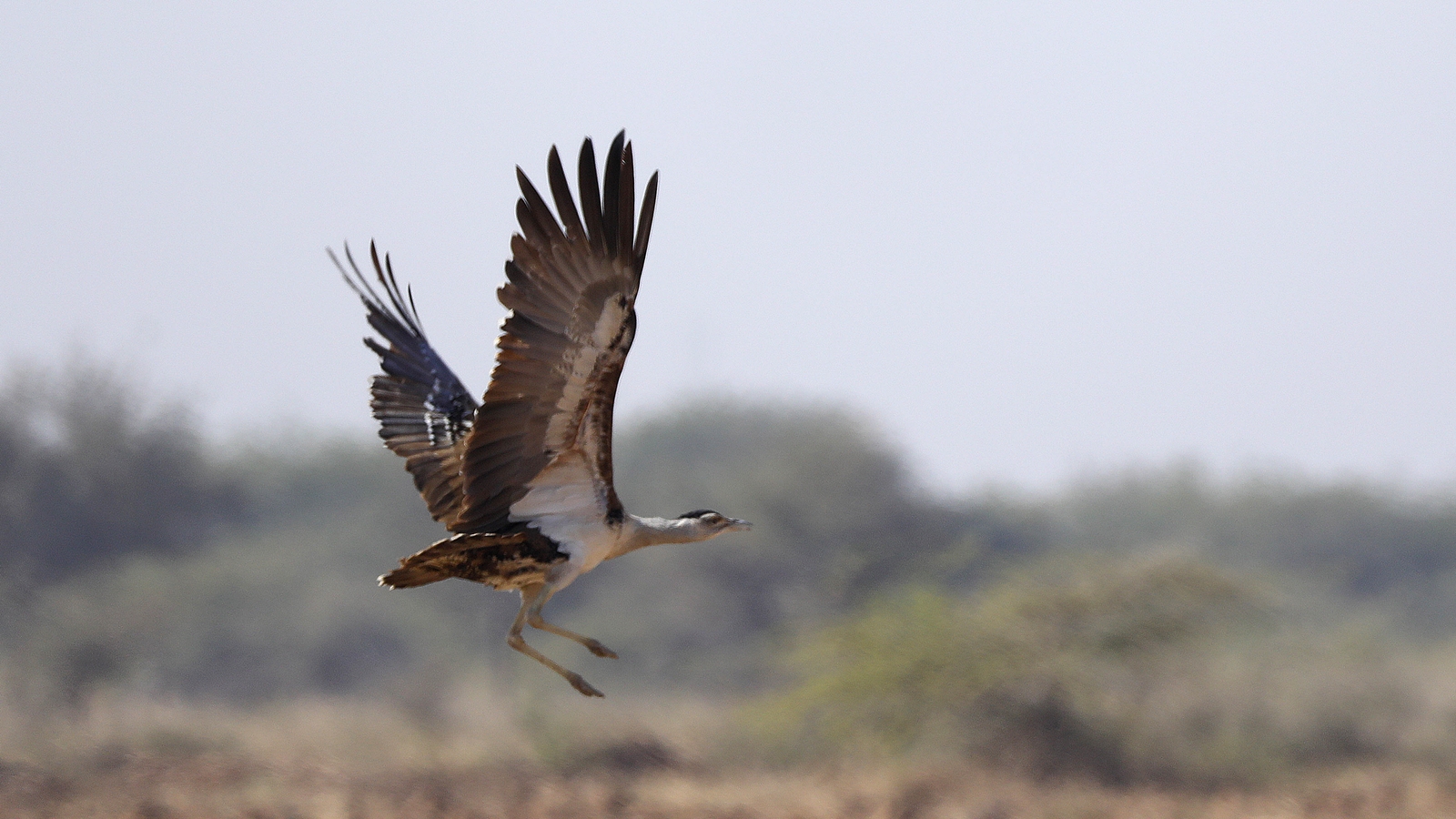
10976250 great-indian-bustard_20250908222129_20251220110614_20261124075611.jpg
- ✓10976250 great-indian-bustard_20250908222129_20251220110614_20261124075611.jpg
- ✓One of them was suspected to have been killed by a fox in 12 days, sparking concerns of predator management in the area.
- ✓In early October, the Project Great Indian Bustard released four male birds – R3, R4, R5 and R6 — into the wild in Rajasthan.
- ✓The second pair followed on October 7 after the first two showed what the report calls “naturalistic behaviour post-release”.
Within days of their release into Rajasthan’s Desert National Park, four captive-bred Great Indian Bustards sometimes tried to approach the facility that had housed them, prompting staff to place a person outside, “partly concealed in Capparis”, to keep them away, The Indian Express has learnt.
One of them was suspected to have been killed by a fox in 12 days, sparking concerns of predator management in the area. In early October, the Project Great Indian Bustard released four male birds – R3, R4, R5 and R6 — into the wild in Rajasthan.
In the days that followed, the institute closely monitored and tracked the birds using GPS-GSM transmitters, observing behaviour from their frequent return to the facility to switching behaviours that helped them adjust to their new wild environs.
The October releases were the first-ever rewilding exercise under the programme. The second pair followed on October 7 after the first two showed what the report calls “naturalistic behaviour post-release”. One of the four released birds died 12 days after release, suspected to have been killed by a fox, the observations, recorded in a post-release report dated October 21 and accessed by The Indian Express, said.
According to the report, the behaviour of the four birds varied. “R3 and R5 stayed near a distance of 200-500 m from the facility for the initial few days, whereas R4 and R6 started exploring far from the facility early,” the report said.
Some of the birds, among them R4 and R6, took “an exploratory flight" – flying in a shallow U-shaped trajectory at a height of around 10 metres above the ground, seemingly exploring their surroundings. Permission has been accorded for the release of up to 25 captive-bred GIB chicks during the year 2026-2027.
Of these, up to 10 birds will be released this year. Explaining the birds’ initial attempts to return, Sutirtha Dutta, scientist and head of Project Great Indian Bustard at WII, told The Indian Express that they had anticipated that the birds would develop an affinity for the place where they had been fed for several months.
“We were expecting that when they don’t find food outside, they will keep on coming to the facility for a very long period of time. But instead, what we saw was that there was an initial affinity for the first few days. When we placed a human as a deterrent, they did not come.
That shows two things. One is that they are afraid of humans, which is a great thing, which is what we wanted. And the second thing is that that affinity quickly dissolved and they moved on after two, three days,” he said.
Explaining the differences in behaviours, Dutta said individual temperaments played a role. “The personalities differ between the birds. Some of the individuals are more scared than the others. All of these birds, when they were released, had a negative association with humans because they had been caught and released outside.
Among behaviours the report says were common to the birds were “wariness towards humans and approaching vehicles”, “hiding in vegetation upon seeing foxes”, and “fission-fusion flocking with each other and wild birds”. The Project GIB report identifies the bird that died as R3.
The report said R3, R4 and R6 “were roosting on a magra on October 15 inside the RKVY enclosure…An active fox den was found within 100 m of this site. A disturbance (most likely a predation attempt) caused all three birds to move around 9 pm in different directions".
The tag was later found at the edge of the enclosure, “right outside the fence”. A search of the area found “a bulk of feathers, bones, and visceral remains” and a tag and rings “completely chewed and severed”. The report concluded that the bird “was eaten by fox(es) on October 16” and said a post-mortem “was not possible as the carcass was completely consumed”.
“All the birds are fitted with transmitters. These transmitters do not transmit data in real time, but after a day. We get data after an interval of time, typically about 18 hours. The whole day’s data gets collected, and then it gets transmitted on the next day,” he said.
He added that the area has generally poor network coverage, which sometimes causes transmission failures and delays in receiving data. In R3’s case, the transmitter had not sent data for almost 36 hours. “We were searching [for] it on the ground without the help of telemetry.
Finally, when we could spot it, it had already been about 24 to 36 hours, and by that time it was largely consumed,” Dutta said. “The site had profuse footprints and faeces of foxes (but no other animals) and trails of fox movement along with carcass remains, within a 200 m radius.” “Based on this, it could be concluded that the bird flew from its roost, landed just outside the RKVY enclosure and was eaten by fox(es) on October 16”.
Dutta said predator management, particularly the translocation of foxes, was an ongoing exercise in the areas where the birds breed. In the minutes of the Meeting of the Project Management Committee (PMC) for Great Indian Bustard Conservation Breeding and Research Program on January 7, 2025, in Aranya Bhavan, Jaipur, Rajasthan, it was stated that “predator translocation from GIB breeding enclosures should not be limited to Desert Fox and Desert Cat, as permitted currently, and should include all potential nest predators.
“This will require permissions under Section 12 of the Wildlife (Protection) Act…Further, these predators may be relocated to areas farther than 70 km and outside the Desert National Park (DNP), as previous experience of releasing them within 50 km and inside DNP has resulted in predators returning to release sites,” the report said.
The Desert National Park covers approximately 3,000 sq. km. A cumulative area of around 200 sq km is secured through chain-link fence enclosures, which constitute the breeding habitat of the Great Indian Bustard. Dutta said the complex, covering approximately 20-25 sq km, accounts for almost 80 percent of the...
- •Aspirants and citizens are advised to monitor official notices and circulars issued by The Indian Express National.
- •Verify all prescribed eligibility criteria, cutoff dates, and authenticated document requirements prior to formal submissions.
- •Track connected examination timetables, vacancy advisories, and administrative gazettes on SuchnaSetu.
| Issuing Authority | The Indian Express National |
|---|---|
| Topic Category | INDIA |
| Jurisdiction | All India / National |
| Publication Date | 24 November 2026 |