
Military Digest | When the British feared airborne invasion of India, raised anti-parachute force
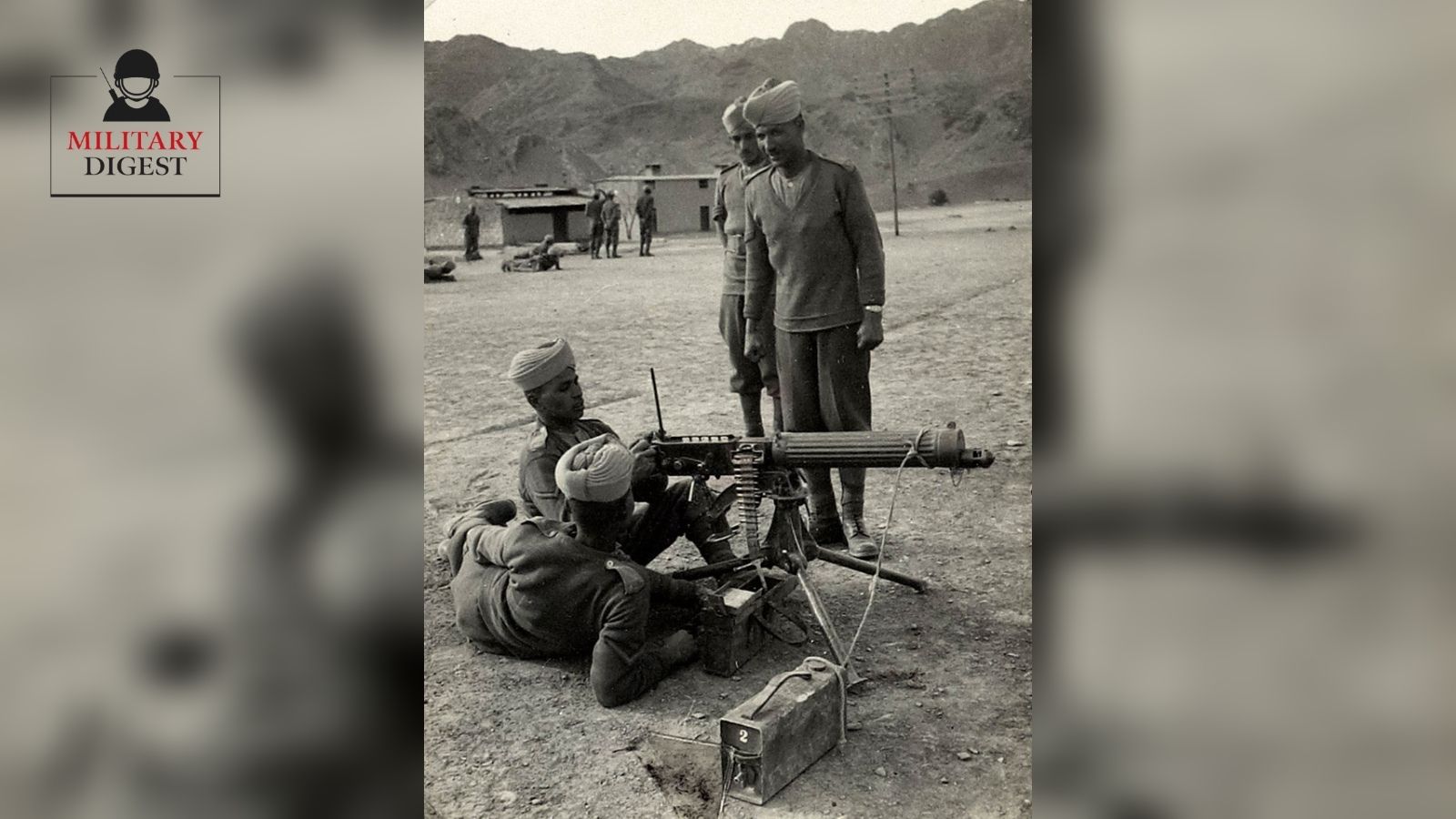
10855661 IIndian Army Vickers machine gun section
- ✓10855661 IIndian Army Vickers machine gun section
- ✓The national archives documents on the issue include a letter written on February 18, 1941, with the subject “Defence of India- Anti-Parachute Columns”.
- ✓There was also a suggestion that it might be possible to pay watchers and messengers a small monthly retaining fee of Rs 2.
As World War II progressed into its third year and the Allied Forces faced continuous reverses on several fronts, the British administration in India began to fear a German army invasion on the western borders. Many measures were taken to address any developing threat through Iran or Afghanistan. This included setting up an anti-parachute force capable of dealing with a sudden influx of enemy troops through an airborne invasion.
The Government of India issued detailed instructions regarding this from New Delhi to the Army authorities. The national archives documents on the issue include a letter written on February 18, 1941, with the subject “Defence of India- Anti-Parachute Columns”. The letter outlines how the government decided to form mobile anti-parachute columns of troops to be located at various centres throughout the Punjab and the North West Frontier Province.
The letter suggested that if any of the states react by suggesting that they should form their own APCs, “it may then (and not before then) be explained, if you see no objection, that the question of the States themselves forming their own anti-parachute columns has been considered but given up as not being practicable for the following reasons:-
(a) the activities of anti-parachute columns would extend over territories of more than one Indian State and also British India, and there would be less difficulty in an anti-parachute column drawn from the Army in India being entrusted with responsibility over such a composite area than an anti- parachute column belonging to any particular State,
(b) unity of command and cooperation would be simplified if anti-parachute columns were all entirely under the control of the Army in India, and this would not be the case if the anti-parachute columns belonged to States; and
(c) the resources of States generally. with their present military commitments, would probably be inadequate to permit of sufficient vehicles, arms and equipment as well as columns being available to form independent anti-parachute columns”.
Aerodrome defence troops had been provided for the static defence of Royal Air Force (RAF) aerodromes and certain civil aerodromes on the trans-Indus air route, against the threat of attack by parachute and/or airborne troops. In addition, at certain stations, local relief columns had been located to provide RAF aerodromes with better defence.
“Apart from attacking established aerodromes and other installations, it might be possible that landings of parachute and/or air-borne troops might be made in the countryside in general. The objects of such might include, as a part of a general plan of aggression against India, to disorganise, to destroy the military system of command and to stop or impede the working of lines of communication areas; to establish touch with or to support insurrection; to spread alarm and confusion among the civil population,” another document related to the subject states.
The British apprehended that the course of action on landing might include attacks on any or all of the following: (a) key points on main communications, viz, important rail and road bridges, important railway junctions, and railway workshops; (b) oil installations, oil stocks, oil fields; c) wireless and radio stations, telephone exchanges and telegraph offices; d) Arsenals, ordnance and supply depots; e) important electric power stations; and f) important government offices, headquarters of military formations.
It was emphasised that the ultimate responsibility for dealing with the threat must fall on the Army, no matter what degree of cooperation may be forthcoming from civil forces.
The directions noted: “Attempts by parachutists and/or other enemy airborne detachments, to support and encourage local sympathisers in internal insurrection, would possibly be directed to supplying them with weapons, as well as interrupting the normal life of the country, by fostering unrest, destroying or at least damaging communications, industries and other important national activities."
The British were of the view that this threat called for a defensive organisation with a degree of dispersion. Although it should be adequately dealt with by armed police—a large number of whom would inevitably be required—it was felt there must also be military support of a special nature in the background.
“To deal with attacks of the nature described above it will be necessary to organise:- (a) A system for transmitting information of enemy landings to the proper authorities. (b) Means whereby enemy who have landed can be shadowed pending the arrival of the necessary forces to deal with them, and finally (c) to locate A.P. Columns at suitable centres to take action or receipt of the information that enemy forces have landed.
It was decided that in most areas there would be no alternative but to rely on the villagers to report the presence of enemy forces. “These villagers must be induced to make report to the nearest police station by the quickest possible means. To achieve a degree of reliability it will be necessary to ensure that every report made in good faith is promptly rewarded,” the letter says.
There was also a suggestion that it might be possible to pay watchers and messengers a small monthly retaining fee of Rs 2. On the other hand, in the North West Frontier Province and Punjab, the British wished to use the existing civil system based on the village headmen and chowkidars.
“On receipt of information at a police station it should be the Station House Officer to forward all particulars to the nearest centre where a mobile column is located. For this to be effective all police stations should have telephones,” it was directed.
Detailed instructions on the matter stated that at each police station there should be a small party of supernumerary armed police or civil guards who should, if possible, be provided with bicycles or ponies. A force of this type would not be capable of attacking a body of determined and well-armed enemy parachutists, nor were they intended to do so unless they happened on the parachutists at the moment of landing or other occasions where they might temporarily be at a disadvantage.
The force should be capable of keeping track of any such enemy party pending the arrival of an anti-parachute column. “Having regard to the fact that enemy parachutists are heavily armed, determined and resourceful men, whose armament will certainly include automatics, light or medium, and grenades, and mıght even include mortar-trained troops, bicycles and motorcycles, it is only suitably armed and well-trained troops who know the country thoroughly, who can bring about their destruction,” the letter says.
- •Aspirants and citizens are advised to monitor official notices and circulars issued by Punjab & Haryana Regional Bureau (Chandigarh).
- •Verify all prescribed eligibility criteria, cutoff dates, and authenticated document requirements prior to formal submissions.
- •Track connected examination timetables, vacancy advisories, and administrative gazettes on SuchnaSetu.
| Issuing Authority | Punjab & Haryana Regional Bureau (Chandigarh) |
|---|---|
| Topic Category | STATES |
| Jurisdiction | PB State |
| Publication Date | 30 August 2026 |