
‘Missiles Should Not Collect Dust’: Zelenskyy Urges NATO To Boost Ukraine's Air Defence
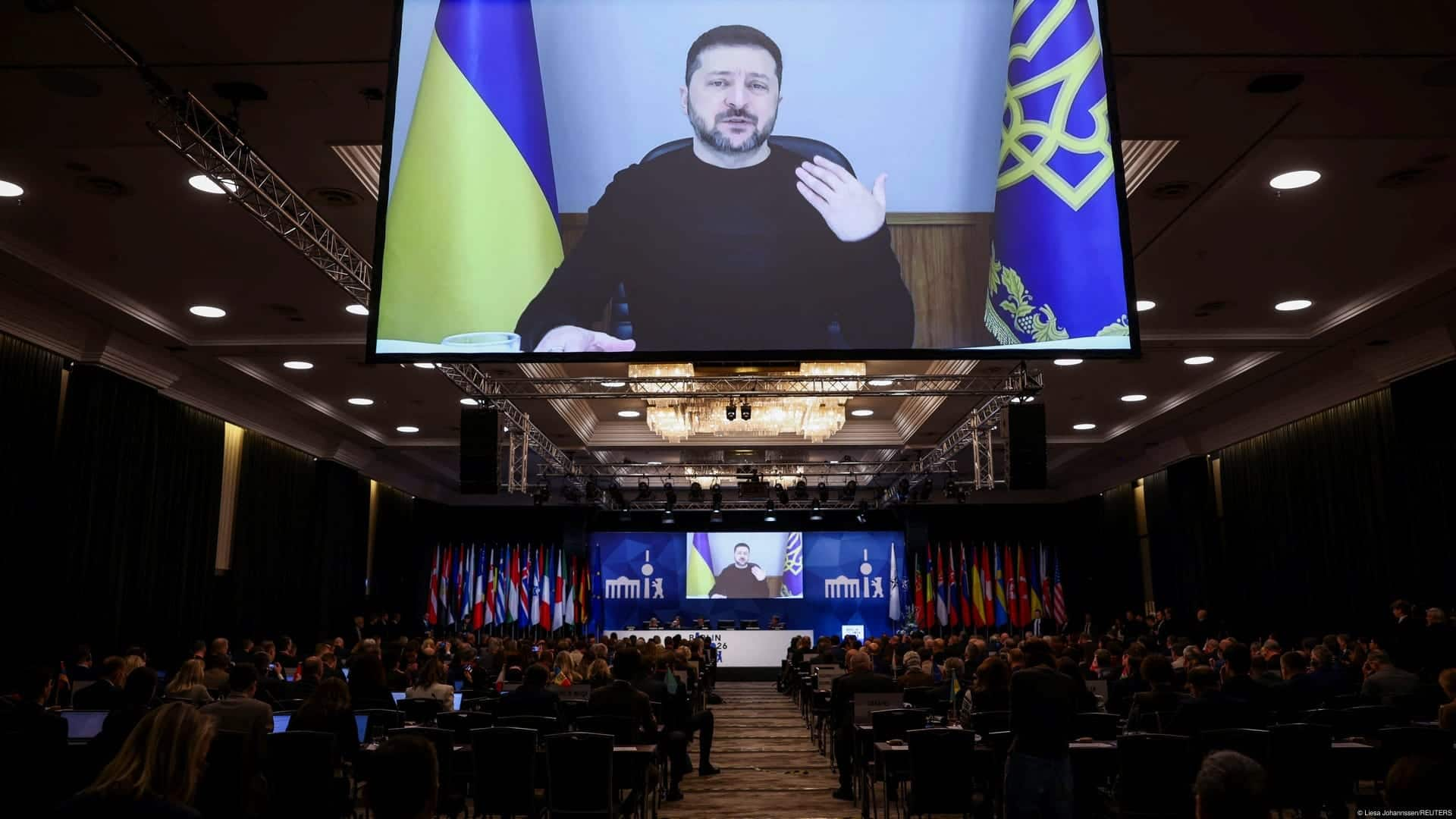
‘Missiles Should Not Collect Dust’: Zelenskyy Urges NATO To Boost Ukraine's Air Defence
- ✓‘Missiles Should Not Collect Dust’: Zelenskyy Urges NATO To Boost Ukraine's Air Defence
- ✓NATO Secretary General Mark Rutte rejected the Ukrainian demands at the summit, which for the first time in 26 years was held in Berlin.
- ✓Members have committed to raising their countries' defense spending to 5% of their gross domestic product (GDP) by 2035.
- ✓For example, the massive increase in military spending: "Our defense budget has tripled since 2021.
It took a while for the video call to connect. When Volodymyr Zelenskyy finally greeted the delegates in Berlin, applause broke out. The Ukrainian president appealed to the gathered parliamentarians from 32 NATO member states to keep supporting his country, especially against the massive aerial bombardment from Russia.
"Dear friends, winter is now ahead of us. And of course, our number one priority is air defense," Zelenskyy told the delegates. His country urgently needs more Patriot and other comprehensive anti-air attack systems. "And your countries have them.
Missiles that can stop Russian ballistic missiles should not be sitting in warehouses collecting dust. And we say this openly. Please help us with this." Zelenskyy renewed his call for his country to join the NATO military alliance.
That issue is not for the NATO Parliamentary Assembly, which was gathered for its 72nd annual meeting in Berlin, to decide. But it was important to the Ukrainian president to reiterate his request. After the war ends, Ukraine needs strong security guarantees and NATO could ensure those.
"Wouldn't it be more effective to simply bring Ukraine into NATO?" Zelenskyy asked, arguing: "Wouldn't that be better for all of us, for everyone? Cheaper to put in place? And more reliable when it comes to actually protecting security?" There is conflict among NATO members about the possibility of admitting Ukraine.
The alliance has affirmed multiple times that the path to membership stands open to Ukraine — however, in the long term rather than the near future. This is primarily because of the ongoing war and the possible assistance obligations of other NATO countries for Ukraine, which was attacked by Russia.
NATO Secretary General Mark Rutte rejected the Ukrainian demands at the summit, which for the first time in 26 years was held in Berlin. Ukraine had entry prospects; however, NATO members currently lack unanimity on this issue.
NATO alone decides who becomes a member. "There is total clarity on that within the alliance," Rutte said. German Chancellor Friedrich Merz advocated for Ukraine to receive security guarantees similar to what NATO members have, in the instance of a possible ceasefire.
In retrospect, it was clear "what a mistake it was not to follow the American suggestion back in 2008 at the NATO summit in Bucharest to admit Ukraine as a member," Merz said at a joint press conference following a meeting with Rutte.
Whether or not a NATO entry for Ukraine could be part of negotiations with Russia is another question, according to Rutte. He approved of current US efforts to bring about peace talks, and how Europe was closely consulting with Ukraine and the US for a unified position.
"But it is also to test now whether Putin is willing to play ball, and then these issues might come up again." The Russian invasion of Ukraine has led to NATO arming itself on a massive scale. Members have committed to raising their countries' defense spending to 5% of their gross domestic product (GDP) by 2035.
Rutte warned that all the allies needed a credible path to get there, "and ideally, they get there sooner than 2035." In addition, he said weapons production among member states needed to further increase because "right now, demand still far exceeds the supply." The contribution by Germany's Bundeswehr armed forces to NATO was explained by Carsten Breuer, Germany's highest-ranking soldier.
For example, the massive increase in military spending: "Our defense budget has tripled since 2021. The goal is to achieve the 5% target, which was set at the summit in The Hague, well before 2035." In the coming year, Germany's defense budget has risen to more than €139 billion ($151 billion).
The Bundeswehr was further developing into a "constantly modernized, effective and innovative army, Breuer said. Also, a much larger one than before: "To reach our current capability goals we are expanding the Bundeswehr to a total of 460,000 soldiers by the mid-2030s," the German chief of defense said.
Of those, 200,000 are to be reservists. "This is like walking a tightrope because we must find the right balance between growth and operational readiness." Following his speech, Breuer answered questions from the delegates who showed keen interest in the developments.
The discussion was a preview of Breuer's new post: He has been voted in as the new chair of the NATO Military Committee and will move to the alliance's headquarters in Brussels mid-next year. Then he will become the principal military advisor to NATO Secretary General Mark Rutte.
"I take this election as a sign of recognition that Germany has now accepted its responsibility as well as its role in security policy," Breuer commented. Disclaimer: This report first appeared on Deutsche Welle, and has been republished on ABP Live as part of a special arrangement.
Apart from the headline, no changes have been made in the report by ABP Live. Ukraine urgently needs more air defense systems, such as Patriot missiles, to counter massive Russian aerial bombardments, especially with winter approaching.
NATO affirms that the path to membership is open for Ukraine, but it's a long-term prospect. Unanimity among members is lacking, primarily due to the ongoing war. NATO members have committed to increasing their defense spending to 5% of their gross domestic product (GDP) by 2035.
They are encouraged to reach this goal sooner. Deutsche Welle is Germany's international broadcaster. As an independent media outlet, Deutsche Welle provides unbiased news and information in 32 languages around the world.
- •Aspirants and citizens are advised to monitor official notices and circulars issued by ABP News.
- •Verify all prescribed eligibility criteria, cutoff dates, and authenticated document requirements prior to formal submissions.
- •Track connected examination timetables, vacancy advisories, and administrative gazettes on SuchnaSetu.
| Issuing Authority | ABP News |
|---|---|
| Topic Category | WORLD |
| Jurisdiction | All India / National |
| Publication Date | 24 November 2026 |