
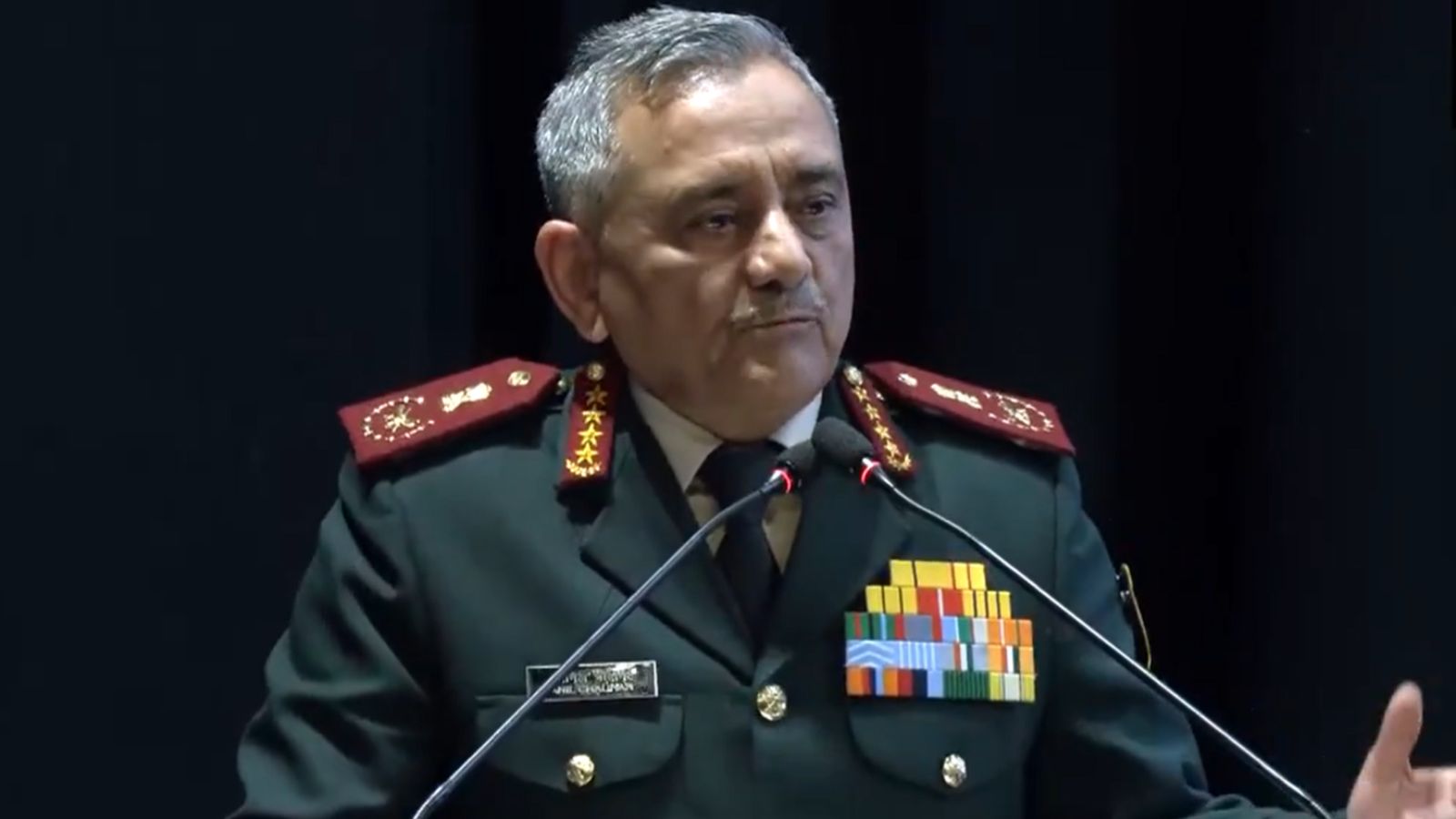
Pakistan will remain significant security concern for times to come: Former CDS Gen Anil Chauhan (retd)
10865042 Anil-Chauhan_20260905225850.jpg
- ✓10865042 Anil-Chauhan_20260905225850.jpg
- ✓Chinese President Xi Jinping is expected to attend the BRICS summit in New Delhi on September 12-13.
- ✓In the last 14 years of her career, she has worked in newspapers as well as in the online media space and is well versed with the functioning of both newsrooms.
- ✓She has been working for The Indian Express since January 2023.
PAKISTAN WILL remain a significant security concern and a potential threat in the foreseeable future, former Chief of Defence Staff Gen Anil Chauhan (retd) said on Saturday. He said Pakistan’s defence pacts with other countries could foster overconfidence and prompt Islamabad to make miscalculations again.
He also emphasised that India’s relationship with China cannot be held hostage to only boundary issues, without referring to any specific issue. Delivering the GB Pant memorial lecture on 'Threats and Challenges to India's Security', he said Operation Sindoor, holding the Indus Waters Treaty in abeyance and some practical measures may hopefully change or induce behavioural change in Pakistan.
Gen Chauhan was referring to Pakistan, Saudi Arabia and Turkiye signing the 'Makkah Joint Defence Agreement' under which an attack against one of them will be treated as an attack against all of them. “India's external threat environment is shared by a large number of factors: unresolved borders… cross-border terrorism, non-state actors, contested spaces which are known as global commons, then expanding cooperation and competition in space, cyber and the maritime domain.
These factors interact,” he said, adding that they cannot be examined separately. "Let me talk about our western neighbour. Pakistan will remain, I think, a major security concern and a threat for times to come," he said.
The former CDS also said the existence of nuclear weapons has created a degree of static stability at the apex level. “And this is what has induced instability at the lowest level. It's classically known as a stability-instability paradox." He said Pakistan has been trying to reduce space for conventional operations and expand the space for sub-conventional operations, that is, terrorism and cross-border activities, adding that terrorism and proxy war have been central to this approach and strategy.
"Non-state actors provide deniability, reduce apparent cost and seek to provoke political and communal consequences. Even when a particular terrorist network is degraded, the enabling ecosystem that's the ideology, the recruitment system, the finance, training, propaganda and state support can recreate it, reorganise it," Gen Chauhan said.
So, India must go by this premise that terrorism and proxy war will remain a "major challenge" for it, he said, adding that the only way you can defeat it is by creating credible deterrence. “And that's what we demonstrated in three cross-border operations — Uri, then Balakot, and then Operation Sindoor.
So, deterrence must operate across the spectrum. India must be able to raise the cost of proxy war and terrorism for Pakistan, so that it stops using this as an instrument of state policy," Gen Chauhan said. Referring to The Indian Express report on Saturday on the scheduled Corps Commander-level talks in the Northeast and the establishment of additional hotlines, Gen Chauhan said it is a welcome development, but India-China relations cannot be held hostage to boundary issues only.
On August 25, National Security Advisor Ajit Doval and Chinese Foreign Minister Wang Yi, who are the special representatives for the boundary talks, met in Beijing. Chinese President Xi Jinping is expected to attend the BRICS summit in New Delhi on September 12-13.
India and China are two major Asian powers, large economies and civilisational states which cooperate in some areas and compete in others. “That's what we're doing as part of SCO and now as part of BRICS,” he said, adding that the future of Asia will depend substantially on how India and China manage this simultaneous rise.
He said the boundary issue (LAC) remains unsettled, and differing perceptions of the boundary, infrastructure construction and force multipliers create “the possibility of friction and escalation”. He said this requires vigilance, credible capabilities, clear agreements and consistent adherence to them.
Amrita Nayak Dutta writes on defence and national security as part of the national bureau of The Indian Express. In the past, Amrita has extensively reported on the media industry and broadcasting matters, urban affairs, bureaucracy and government policies.
In the last 14 years of her career, she has worked in newspapers as well as in the online media space and is well versed with the functioning of both newsrooms. Amrita has worked in the northeast, Mumbai and Delhi. She has travelled extensively across the country, including in far-flung border areas, to bring detailed reports from the ground and has written investigative reports on media and defence.
She has been working for The Indian Express since January 2023. ... Read More
- •संबंधित उम्मीदवार अथवा नागरिक The Indian Express National के आधिकारिक पोर्टल पर समय-समय पर जारी अतिरिक्त दिशानिर्देशों का अवलोकन करें।
- •अधिसूचना में उल्लिखित समय-सीमा, पात्रता शर्तों एवं आवश्यक दस्तावेजों की पूर्व जांच सुनिश्चित करें।
- •सूचना सेतु पर इस विषय से जुड़ी आगामी परीक्षा तिथियों, भर्ती विज्ञापनों और परिणाम अपडेट्स को ट्रैक करते रहें।
| जारीकर्ता प्राधिकरण | The Indian Express National |
|---|---|
| विषय श्रेणी | INDIA |
| क्षेत्र / अधिकार क्षेत्र | अखिल भारतीय (राष्ट्रीय) |
| सार्वजनिक तिथि | 5 सितंबर 2026 |