
Punjab’s plan to grow different crops is failing, rice now rules 92% of the land
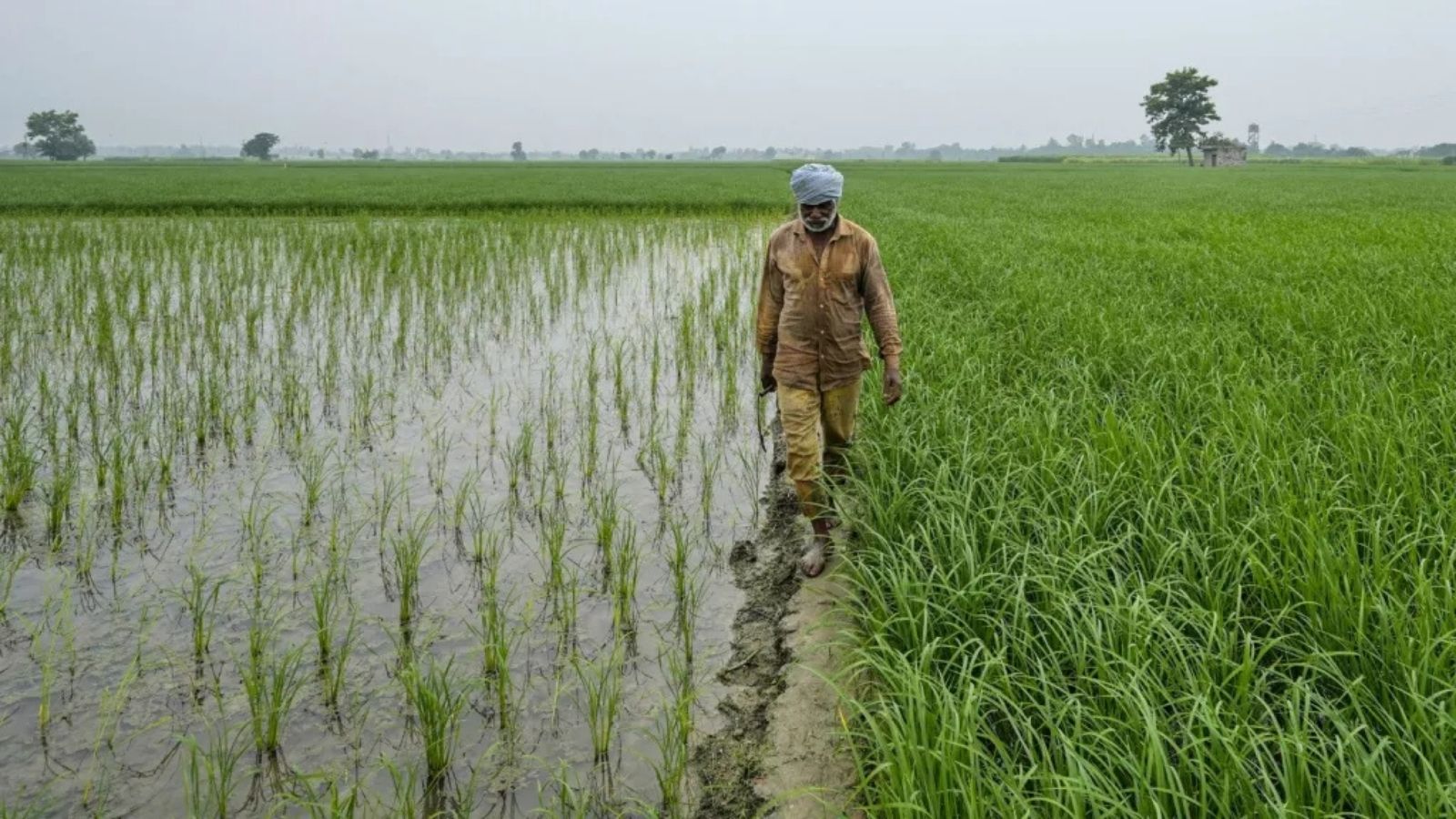
10854916 Punjab paddy
- ✓10854916 Punjab paddy
- ✓The current figure is being reportpafded as an all-time high, with rice now covering more than 92% of Punjab's Kharif cultivation area.
- ✓A decade ago, in 2016-17, rice occupied 28.98 lakh hectares, or about 80.5% of the same roughly 36-lakh-hectare agricultural area.
- ✓In another story, the area left for crops other than paddy has fallen from about 7.02 lakh hectares in 2016-17 to just 2.69 lakh hectares now.
Punjab has spent years searching for a way out of its paddy-dominated agricultural economy. But the latest kharif acreage numbers suggest that, rather than diversifying, the state is becoming even more dependent on highly water-intensive rice.
The current figure is being reportpafded as an all-time high, with rice now covering more than 92% of Punjab's Kharif cultivation area.
With the 2026 Kharif sowing season drawing to a close, rice, including paddy (Parmal or non-Basmati) and Basmati, has reached a record 32.86 lakh hectares of the total 35.554 lakh hectares devoted to agriculture during the kharif season. Punjab has around 41,00,000 net sown area during the kharif season out of which roughly 36 lakh hectares come under agricultural props and remaining under horticultural crops.
A decade ago, in 2016-17, rice occupied 28.98 lakh hectares, or about 80.5% of the same roughly 36-lakh-hectare agricultural area.
In another story, the area left for crops other than paddy has fallen from about 7.02 lakh hectares in 2016-17 to just 2.69 lakh hectares now. That is a reduction of approximately 4.33 lakh hectares — or nearly 62%.
If individual crops are examined, it is seen that cotton saw a 72% decline in area. Cotton covered 2.85 lakh hectares in 2016-17 but by 2026-27, it had fallen to just 80,000 hectares, which is an all-time low. A crop that once formed the agricultural backbone of large parts of the Malwa region has been pushed to the margins.
Meanwhile, maize area has also gone down by 25%. Maize acreage, which stood at 1.16 lakh hectares in 2016-17, has fallen to about 87,000 hectares in 2026-27. This is particularly significant because maize is frequently presented as one of Punjab's most practical alternatives to paddy. The state has the potential to grow maize on around 5 to 6 lakh hectares to meet the state's consumption. Yet farmers have not responded to that policy message by substantially increasing maize cultivation.
Sugarcane has, however, remained relatively stable. Its acreage increased from approximately 88,000 hectares in 2016-17 to 97,000 hectares now — an increase of only around 10% over a decade.
That is nowhere near enough to absorb the acreage that would have to move out of paddy for meaningful diversification. Punjab has the potential to grow sugarcane on 2.25 lakh hectares. The decline in pulses is also worrying. Kharif moong, mash/urad and arhar together covered around 15,000-16,000 hectares during 2016-17. By 2026-27, the area is reported at around 3,000 hectares. That represents an extraordinary decline of roughly 81%.
For a state confronting soil degradation, groundwater depletion and the need for a more diverse agricultural system, the disappearance of pulses is a problem. The state is not even growing the 15% of the required consumption of pulses.
So why does the farmer keep choosing paddy and avoid diversification?
This is where the debate needs to move beyond blaming the farmer.
“Punjab's farmer is making an economic calculation. From the farmer's perspective, rice continues to offer something that most alternatives cannot match — a relatively dependable combination of yield, procurement and market access,” said farmer Talwinder Singh from Jalandhar, who grows paddy on around 50 acres of land.
“For paddy, Punjab has an enormous procurement ecosystem built around government agencies, mandis, rice mills, transport and storage. For many alternative crops, the farmer may have an MSP on paper but still faces the question: Who will buy my crop, and at what price?” said farmer leader Jagmohan Singh, general secretary of Bharatiya Kisan Union (BKU) Dakaunda.
The irony is that several alternative kharif crops have MSPs far higher than paddy on a per-quintal basis. For the 2026-27 marketing season, the Centre fixed MSP for Paddy common at Rs 2,441 and for Grade A it is Rs 2,461; for maize its Rs 2,410; Cotton (medium staple) it is Rs 8,267, among others.
The gap is enormous, yet farmers continue to devote more land to paddy because MSP for alternative crops is only on papers. “You give assured MSP to farmers for every crop as per the formula based on the MS Swaminathan report, and diversification will automatically take place,” said Jagmohan Singh.
A farmer also looks at what comes out of an acre. The yield figures provided for this analysis put average paddy production at roughly 28-30 quintals per acre, compared with approximately 23-25 quintals for maize, 7-8 quintals for cotton and 5-6 quintals for pulse.
Punjab Agriculture and Farmers Welfare Minister Gurmeet Singh Khuddian has argued that the Centre needs to support Punjab financially if the state is to diversify. Punjab, he has maintained, played a major role in helping the country move from a food-deficit to a food-surplus nation, and the onus is now on the Centre to support the state in shifting towards a more sustainable cropping pattern.
- •Aspirants and citizens are advised to monitor official notices and circulars issued by Punjab & Haryana Regional Bureau (Chandigarh).
- •Verify all prescribed eligibility criteria, cutoff dates, and authenticated document requirements prior to formal submissions.
- •Track connected examination timetables, vacancy advisories, and administrative gazettes on SuchnaSetu.
| Issuing Authority | Punjab & Haryana Regional Bureau (Chandigarh) |
|---|---|
| Topic Category | STATES |
| Jurisdiction | PB State |
| Publication Date | 29 August 2026 |