
University of Hong Kong launches robotics engineering programme; Indian students with 93% in CBSE, ISC can apply
10979193 robots
- ✓Of these, 5,000 seats will be in Robotics and Physical AI, including 2,500 BTech seats.
- ✓That is the mindset we want students to develop from Year 1.
- ✓HKU is ranked 11th globally in the QS World University Rankings 2027.
- ✓HKIE and India's National Board of Accreditation are both...
Robots are increasingly moving beyond factory floors, finding applications in everyday services. As artificial intelligence (AI), automation and autonomous systems reshape industries, the demand for engineers who can design, develop and operate these technologies is growing.
Recently, the Indian Institutes of Technology (IITs), in partnership with the Bhupat and Jyoti Mehta Family Foundation, announced the introduction of around 6,000 additional seats. Of these, 5,000 seats will be in Robotics and Physical AI, including 2,500 BTech seats.
Many foreign universities are already offering specialised programmes in this field. For Indian students looking to pursue careers in this emerging area, the University of Hong Kong (HKU) has recently introduced a dedicated four-year Bachelor of Engineering programme in Robotics Engineering.
In an interview with the indianexpress.com, Professor Fu Zhang, programme director of the Bachelor of Engineering in Robotics Engineering, discusses the curriculum, admission requirements, industry exposure, scholarships and career opportunities.
Also Read | Wrong founding year, Canadian weather: Bizarre reasons behind UK student visa refusals What prompted HKU to introduce a dedicated 4-year Bachelor of Engineering in Robotics Engineering? Robotics has grown into a distinct engineering discipline.
In Hong Kong, innovation, AI and advanced manufacturing are now strategic priorities. Across the Greater Bay Area, we see fast growth in embodied AI and drones, and companies need engineers who understand autonomous systems, perception, control, and AI integration.
Globally, employers expect these technologies to reshape their businesses in the coming years. Building a robot that works reliably in the real world requires mechanical design, electronics, sensing, control, computing, and AI to come together as one system.
Traditionally, students learn these pieces separately in mechanical, electrical or computer engineering, data and systems engineering, and civil engineering, and they learn to integrate them only later, often on the job.
The gap we want to close is systems-level integration. Industry needs engineers who understand the whole robot, from hardware and sensors to the algorithms that let it perceive, decide, and act, and who can make those parts work together safely.
That is why the programme brings four departments into one coherent curriculum, rather than offering robotics as a set of electives. From my own research on autonomous aerial robots, the hardest problems are rarely in one component.
They come from making sensing, planning, and control work together at high speed on a small onboard computer. That is the mindset we want students to develop from Year 1. China has reportedly scrapped more than 12,000 undergraduate degree programmes in recent years as universities realign courses with changing industry requirements.
Against this backdrop, what is driving HKU to introduce a specialised undergraduate programme in robotics? Universities everywhere are reviewing their programmes as technology changes what employers need. At HKU Engineering, we developed this programme because of the strength we see in our own research and the needs arising from our industry partnerships.
We expect long-term demand to be strong. According to the International Federation of Robotics, a record 603,000 industrial robots were installed worldwide in 2025, and more than five million are now in operation. Beyond factories, robots are moving into logistics, inspection, healthcare, construction and the low-altitude economy.
These systems increasingly rely on AI, so the demand is not just for robot operators but for engineers who can design, integrate and improve intelligent autonomous systems. A dedicated degree also prepares students for an area that will keep changing.
We focus on strong fundamentals in mathematics, mechanics, electronics, programming and AI, so graduates can adapt as the technology evolves. How does this interdisciplinary model differ from a conventional engineering degree?
The programme draws on the complementary strengths of four departments within HKU’s Faculty of Engineering to provide an integrated education in robotics. Mechanical Engineering contributes expertise in robot mechanisms, mechanics, dynamics and motion control, while Electrical and Computer Engineering provides the foundations in circuits, sensors, embedded systems and computing hardware.
Data and Systems Engineering brings expertise in data, optimisation and the design of large intelligent systems, and Civil Engineering connects these capabilities to practical applications in construction, infrastructure and inspection robotics.
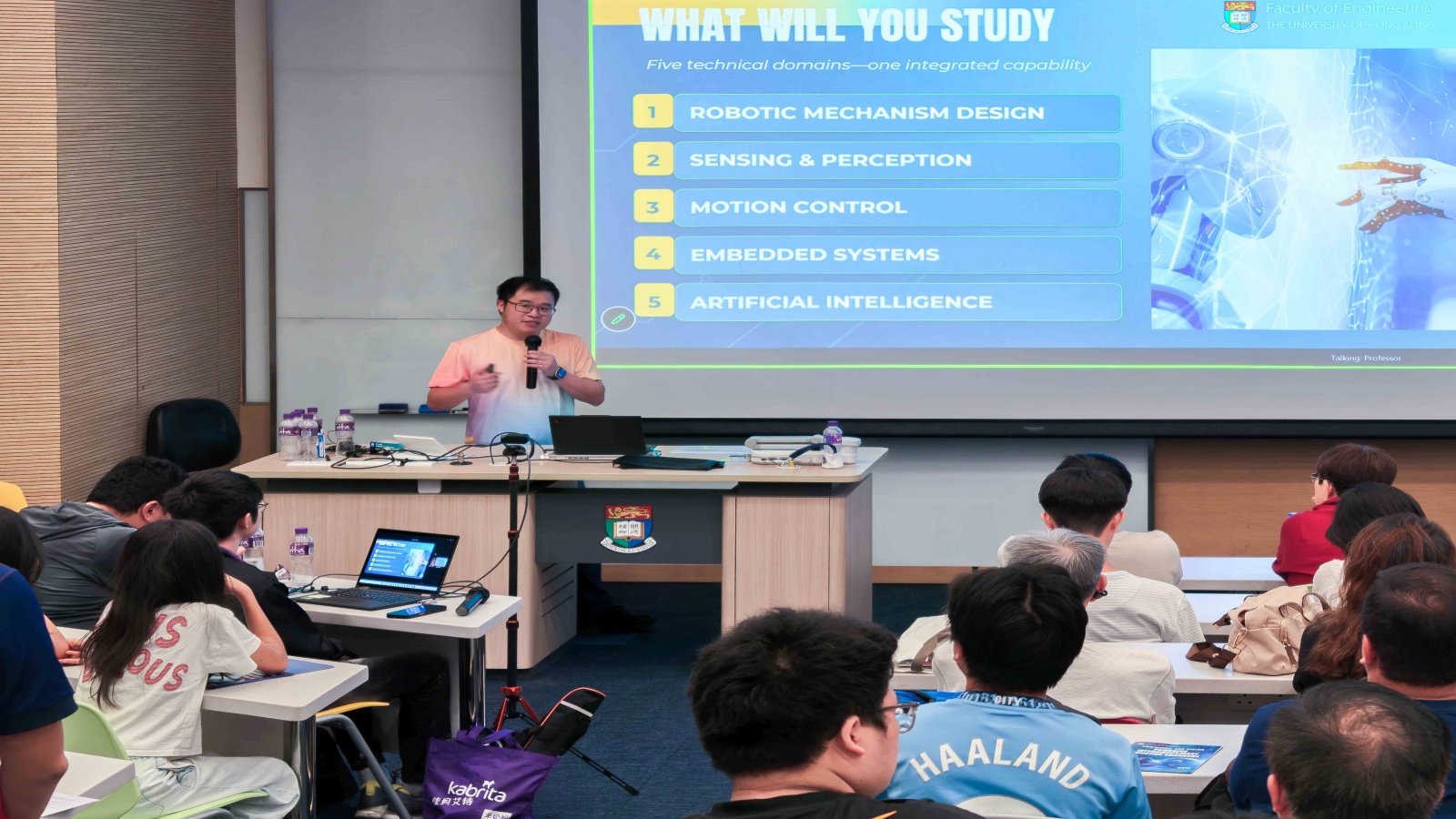
In this programme, the curriculum is designed around the robot as a complete system from the start. Students learn mechanism design, sensing and perception, motion control, embedded systems, and AI as connected subjects.
They then apply them together in laboratories, multidisciplinary design projects, and a capstone project. Students also have access to faculty and research labs across all four departments. What distinguishes Hong Kong as a destination for international students pursuing technology and engineering education compared with established destinations such as the US, UK, Singapore and Australia?
Hong Kong offers a combination that is difficult to find elsewhere: a world-class, English-medium university and access to one of the world's largest robotics ecosystems. HKU is ranked 11th globally in the QS World University Rankings 2027.
Hong Kong is also located next to the Greater Bay Area's hardware and innovation ecosystem. The programme further offers a Shanghai study year linked to the Yangtze River Delta's advanced manufacturing hub. Another advantage is international recognition.
The proposed programme's curriculum is aligned with the academic requirements of the Hong Kong Institution of Engineers. HKIE and India's National Board of Accreditation are both...
- •Aspirants and citizens are advised to monitor official notices and circulars issued by Indian Express Education.
- •Verify all prescribed eligibility criteria, cutoff dates, and authenticated document requirements prior to formal submissions.
- •Track connected examination timetables, vacancy advisories, and administrative gazettes on SuchnaSetu.
| Issuing Authority | Indian Express Education |
|---|---|
| Topic Category | EDUCATION |
| Jurisdiction | All India / National |
| Publication Date | 26 November 2026 |