
Why Punjab’s paddy math doesn’t add up: Crop estimate 181 LMT, arrivals 190 LMT
10967261 punjab paddy (1)
- ✓10967261 punjab paddy (1)
- ✓The Agriculture Department conducted more than 2,300 CCEs across Punjab during the 2026 harvesting season to assess actual yields.
- ✓Results of about 93 per cent of the experiments are in and show an average yield of 69.70 quintals per hectare.
- ✓Punjab has around 32.86 lakh hectares under rice cultivation.
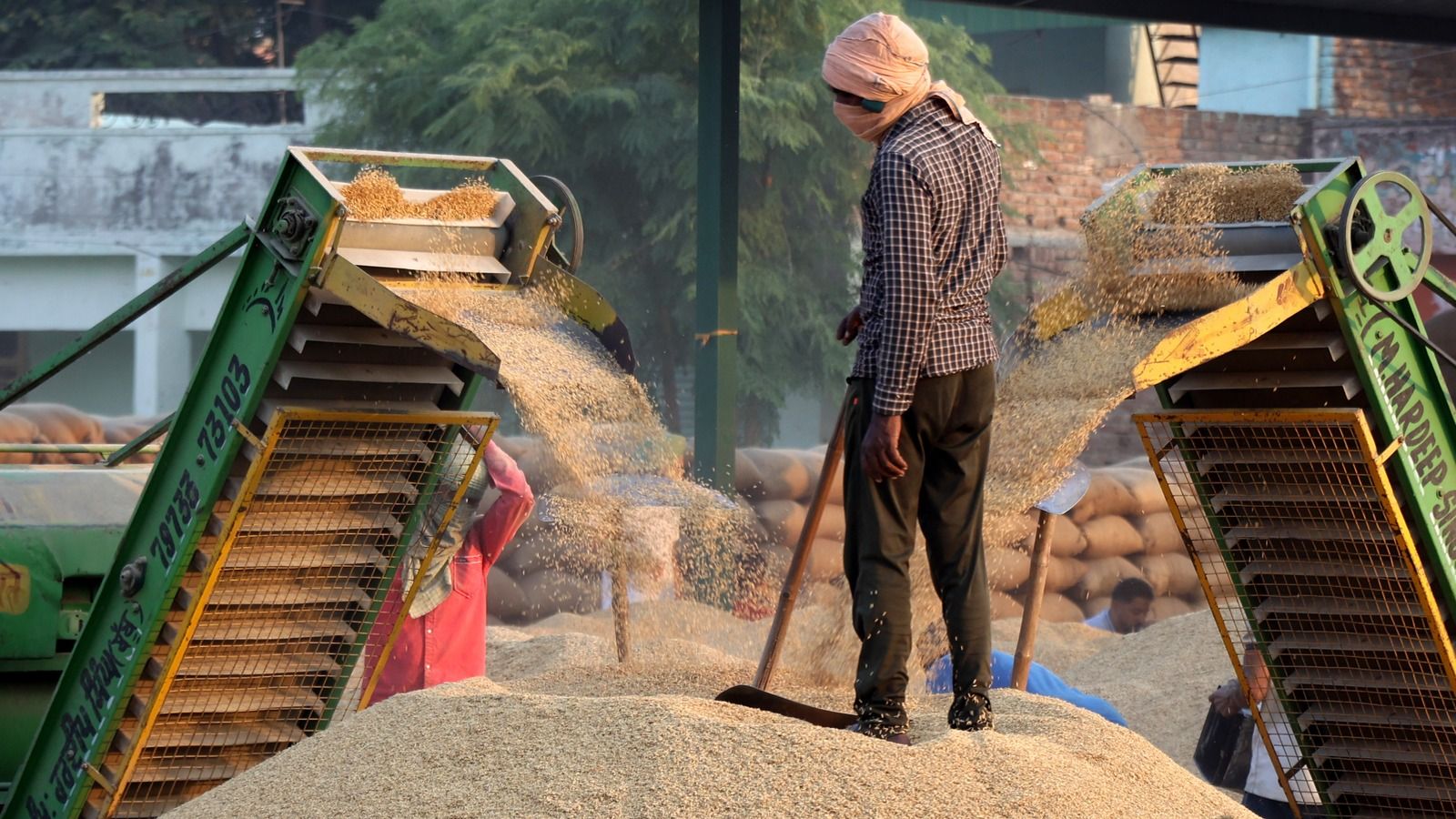
Punjab’s paddy arrivals this season are throwing up a mismatch between field-level yield estimates and the volume of grain reaching mandis, with the latter projected to cross 200 lakh metric tonnes (LMT). While the Agriculture Department’s crop-cutting experiments (CCEs) indicate that non-Basmati paddy production could be around 181 LMT, almost in line with the Centre’s procurement target of 180 LMT, arrivals had already reached 189.75 LMT by November 16.
The gap has assumed significance as the state weighs whether to urge Centre to enhance the procurement target and grant extra funds for the same. Government agencies had procured around 183.13 LMT by November 16 — more than 3 LMT above the Centre’s target — even as the state assesses how much paddy is still to arrive.
The Agriculture Department conducted more than 2,300 CCEs across Punjab during the 2026 harvesting season to assess actual yields. Results of about 93 per cent of the experiments are in and show an average yield of 69.70 quintals per hectare.
Punjab has around 32.86 lakh hectares under rice cultivation. Of this, about 6.85 lakh hectares were initially estimated to be under Basmati, leaving nearly 26.01 lakh hectares under non-Basmati paddy. At an average yield of 69.70 quintals per hectare, the estimated production from 26.01 lakh hectares works out to around 181.29 LMT.
The calculation is significant because the Centre’s procurement target applies to non-Basmati paddy, while Basmati is largely procured by private traders. On the basis of the provisional acreage and CCE yield, therefore, the state’s non-Basmati production is broadly in line with the procurement target.
However, the acreage figures could hold the key to the apparent mismatch. Agriculture Department officials say the initial estimate of 6.85 lakh hectares under Basmati may have changed. In several districts, some land initially recorded under Basmati may have eventualluy have been brought under non-Basmati varieties.
If the final Basmati acreage is lower, the area under non-Basmati paddy, and consequently its total production, would be higher than the current estimate. “The actual area under paddy and Basmati will become clear only after the Revenue Department completes its assessment,” said a senior Agriculture Department officer.
Agriculture Minister Gurmeet Singh Khudian attributed the higher-than-expected arrivals primarily to increased yields. Asked how arrivals could exceed the Centre’s procurement target when the provisional non-Basmati acreage of around 26 lakh hectares multiplied by the CCE yield indicated production of only around 181 LMT, Khudian said the acreage figures were provisional and based on field reports received by the Agriculture Department.
He said there were indications that Basmati acreage had declined in several districts compared with the initial estimates. Some of the land counted as under Basmati could, therefore, have been under non-Basmati paddy. “This, along with the higher yield, could explain the larger volume of paddy arriving in mandis,” Khudian said.
- •Aspirants and citizens are advised to monitor official notices and circulars issued by Punjab & Haryana Regional Bureau (Chandigarh).
- •Verify all prescribed eligibility criteria, cutoff dates, and authenticated document requirements prior to formal submissions.
- •Track connected examination timetables, vacancy advisories, and administrative gazettes on SuchnaSetu.
| Issuing Authority | Punjab & Haryana Regional Bureau (Chandigarh) |
|---|---|
| Topic Category | STATES |
| Jurisdiction | PB State |
| Publication Date | 17 November 2026 |