
Temple restoration work on Goa island unearths relics from 14th to 16th century
10862147 goa-temple
- ✓10862147 goa-temple
- ✓The temple was destroyed during the Bahmani rule and it was subsequently rebuilt in 1391 by a minister in the Vijayanagar kingdom.
- ✓The deity’s idol was shifted across the river to Bicholim, where Maratha warrior king Chhatrapati Shivaji Maharaj established a new temple in 1668.
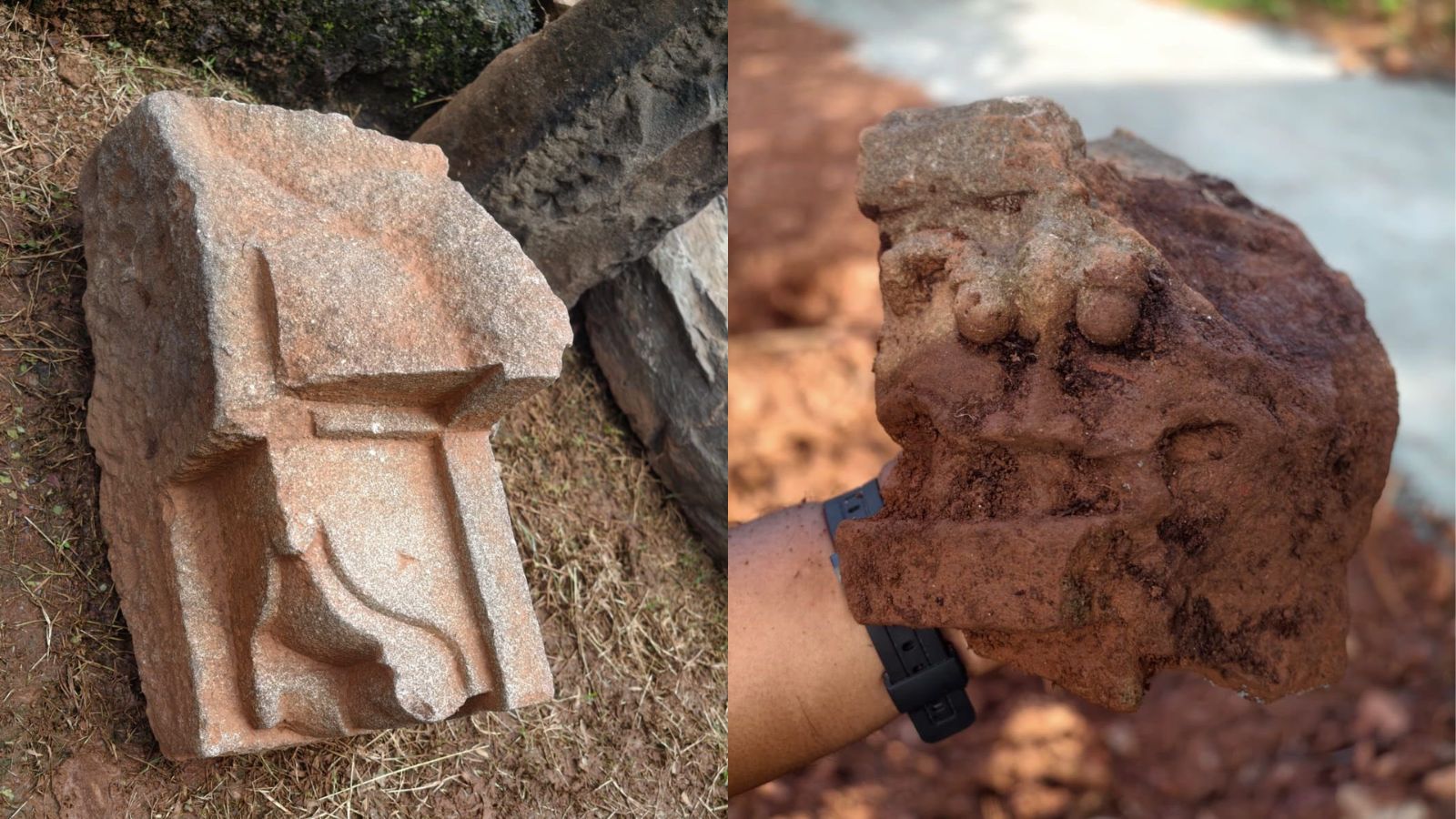
Ancient relics dating between the 14th and 16th centuries, indicating the existence of an ancient temple complex and a corridor, have been found during restoration work at the old site of Saptakoteshwar temple in Goa’s Divar island, Chief Minister Pramod Sawant said on Thursday.
The archaeological discoveries include a ‘Kirtimukh’ motif, which is traditionally carved above temple doorways, and a carved capital of a temple pillar. The CM said these successive era temple relics are an important archaeological discovery that strengthen the historical chronology and sacred legacy of this ancient site in Goa In a post on X, Sawant said important archaeological discoveries have emerged during the restoration work at the sacred site of Shree Saptakoteshwar Temple in Divar.
“Relics and remains dating between the 14th and 16th centuries have been found along the old pathway between Koti Tirth and Madhavachi Talli, indicating the existence of an ancient temple complex and sacred corridor,” he wrote.
“Among the significant finds are a Kirtimukh motif traditionally carved above temple doorways, a carved capital of a temple pillar and parts of Dev Khostam used for placing idols. The variety of stone typologies and temple motifs points towards successive reconstruction of the temple during the Vijayanagar period, following the destruction of the earlier Kadamba period temple,” he added.
Sawant announced the findings a day ahead of a programme titled “Udakshanti and Ganga Pujan” organised by the Department of Archives under the “Kotiteerth Corridor Development Project”, which is being built as a pilgrimage site for temples destroyed during the Portuguese rule, starting the 16th century.
The CM said these successive era temple relics are an important archaeological discovery that strengthen the historical chronology and sacred legacy of this ancient site in Goa, adding that the government remains committed to preserving and restoring the state’s rich civilisational heritage.
Important archaeological discoveries have emerged during restoration work at the sacred site of Shree Saptakoteshwar Temple, Diwar. Relics and remains dating between the 14th and 16th centuries have been found along the old pathway between Koti Tirth and Madhavachi Talli,… pic.twitter.com/nO7Htljs2w — Dr.
Pramod Sawant (@DrPramodPSawant) September 3, 2026 In September last year, Sawant had announced that the cabinet had granted approval for development of a ‘Koti Tirth corridor’, where a new Saptakoteshwar temple – destroyed during Portuguese rule in the state – would be constructed at the old historic site in Divar.
Sawant had said that nearly 1,000 temples in Goa were destroyed by the Portuguese and the project was part of the government’s effort to restore such places of worship. The government formed a high-level committee last year chaired by the secretary of the archaeology department to plan, execute, and oversee the development of the corridor.
“It was everyone’s opinion that if so many temples were demolished…this kind of a corridor will be established and a big temple will be built on 10,000 square metres of land by the government so that we have a memorial where people can worship,” Sawant said at the time.
According to historical records, the site of Saptakoteshwar temple at Naroa in Divar existed during the Kadamba dynasty (10th to 14th century). The rock cut tank of the temple was called ‘Koti-Tirth’. The temple was destroyed during the Bahmani rule and it was subsequently rebuilt in 1391 by a minister in the Vijayanagar kingdom.
The Portuguese destroyed the temple in the 16th century. The deity’s idol was shifted across the river to Bicholim, where Maratha warrior king Chhatrapati Shivaji Maharaj established a new temple in 1668. The Goa government had also formed an expert committee in 2023 to scrutinise applications for consideration and selection of suitable sites for reconstruction and restoration of temples destroyed during Portuguese rule in the state.
In its report to the archaeology department, the expert committee observed that “more than a thousand temples were destroyed” and recommended a temple memorial (Smarak Devalaya) to be built in the erstwhile Old Conquests areas.
“Keeping in mind the large number of temples and deities which existed in Goa during the pre-Portuguese period which were destroyed by the Portuguese… the committee recommends a temple memorial to be built, anywhere in the erstwhile Old Conquests, consisting of the modern Salcete, Bardez and Tiswadi talukas, which bore the brunt of the temple destruction spree of the Goa Inquisition and colonial policies… and re-establishing those deities whose original sites have been usurped by the colonial rule,” the report said.
Pavneet Singh Chadha is the Goa Correspondent of The Indian Express. His reporting focuses intensely on the state of Goa, covering major developments in politics, governance, and significant local events, which establishes his high degree of Expertise and Authority in the region.
Expertise Geographic Expertise: As the Goa correspondent, Pavneet provides on-the-ground, comprehensive coverage of Goa's political, social, and cultural landscape, ensuring readers receive timely and localized insights.
Key Coverage Focus: His recent work demonstrates deep investigative capabilities and a focus on high-impact stories, including: Investigative Reporting: Extensive coverage of complex events such as major incidents (e.g., the Goa nightclub fire), tracing the legal, political, and safety lapses involved.
Government and Law Enforcement: Detailed tracking of police actions, deportations, and legal proceedings related to significant local cases. Policy and Governance: Reporting on the judiciary (e.g., Goa High Court flagging illegal structures) and the actions of government departments.
He tweets @pub_neat ... Read More
- •Aspirants and citizens are advised to monitor official notices and circulars issued by The Indian Express National.
- •Verify all prescribed eligibility criteria, cutoff dates, and authenticated document requirements prior to formal submissions.
- •Track connected examination timetables, vacancy advisories, and administrative gazettes on SuchnaSetu.
| Issuing Authority | The Indian Express National |
|---|---|
| Topic Category | INDIA |
| Jurisdiction | All India / National |
| Publication Date | 3 September 2026 |